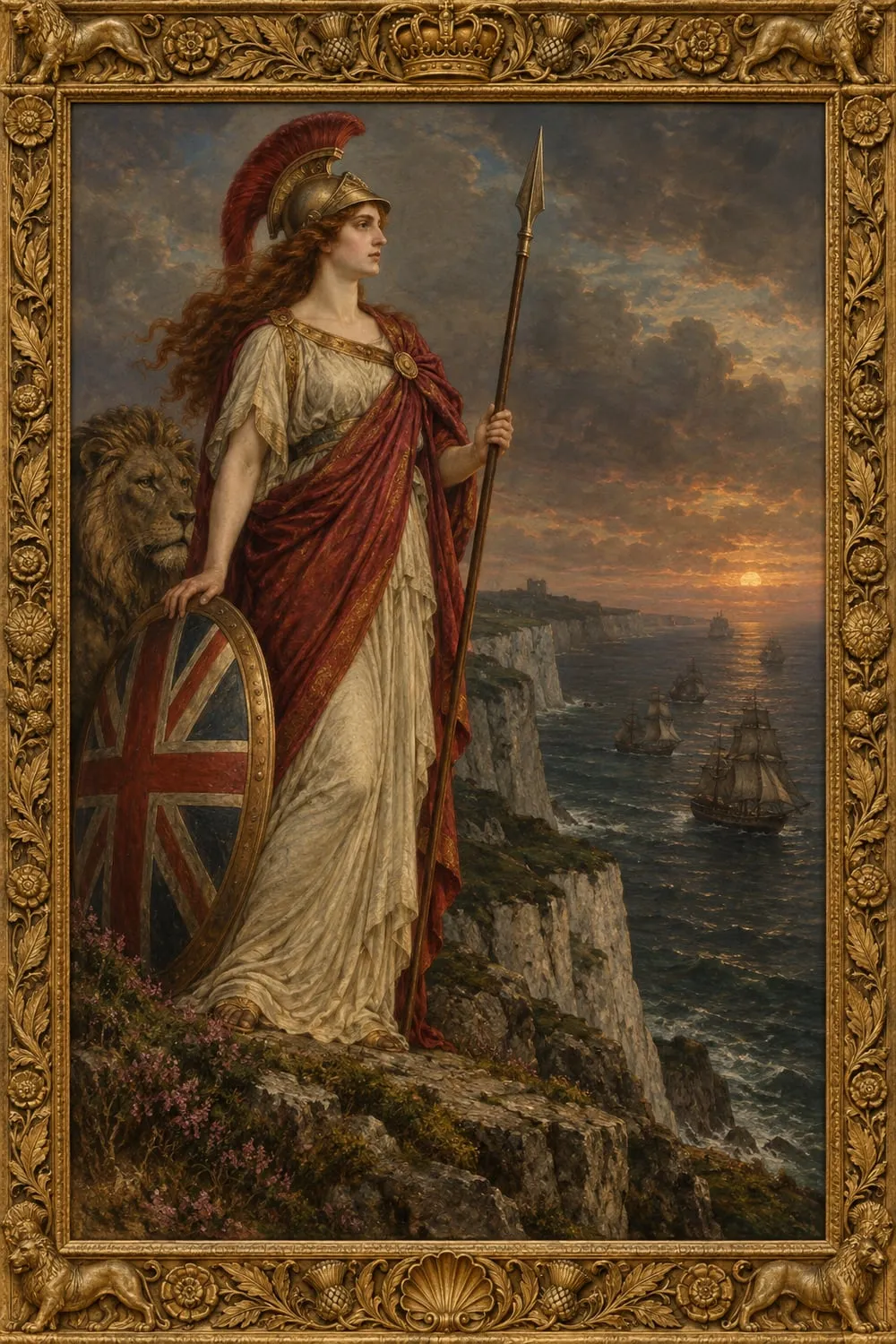
England's empire and its dead
Ave Imperatrix
"Clutching his flag, the dead boy lies."
Poem
Set in this stormy Northern sea,Queen of these restless fields of tide,England! what shall men say of thee,Before whose feet the worlds divide?
The earth, a brittle globe of glass,Lies in the hollow of thy hand,And through its heart of crystal pass,Like shadows through a twilight land,
The spears of crimson-suited war,The long white-crested waves of fight,And all the deadly fires which areThe torches of the lords of Night.
The yellow leopards, strained and lean,The treacherous Russian knows so well,With gaping blackened jaws are seenLeap through the hail of screaming shell.
The strong sea-lion of England’s warsHath left his sapphire cave of sea,To battle with the storm that marsThe stars of England’s chivalry.
The brazen-throated clarion blowsAcross the Pathan’s reedy fen,And the high steeps of Indian snowsShake to the tread of armèd men.
And many an Afghan chief, who liesBeneath his cool pomegranate-trees,Clutches his sword in fierce surmiseWhen on the mountain-side he sees
The fleet-foot Marri scout, who comesTo tell how he hath heard afarThe measured roll of English drumsBeat at the gates of Kandahar.
For southern wind and east wind meetWhere, girt and crowned by sword and fire,England with bare and bloody feetClimbs the steep road of wide empire.
O lonely Himalayan height,Grey pillar of the Indian sky,Where saw’st thou last in clanging flightOur wingèd dogs of Victory?
The almond-groves of Samarkand,Bokhara, where red lilies blow,And Oxus, by whose yellow sandThe grave white-turbaned merchants go:
And on from thence to Ispahan,The gilded garden of the sun,Whence the long dusty caravanBrings cedar wood and vermilion;
And that dread city of CaboolSet at the mountain’s scarpèd feet,Whose marble tanks are ever fullWith water for the noonday heat:
Where through the narrow straight BazaarA little maid CircassianIs led, a present from the CzarUnto some old and bearded khan—
Here have our wild war-eagles flown,And flapped wide wings in fiery fight;But the sad dove, that sits aloneIn England—she hath no delight.
In vain the laughing girl will leanTo greet her love with love-lit eyes:Down in some treacherous black ravine,Clutching his flag, the dead boy lies.
And many a moon and sun will seeThe lingering wistful children waitTo climb upon their father’s knee;And in each house made desolate
Pale women who have lost their lordWill kiss the relics of the slain—Some tarnished epaulette—some sword—Poor toys to soothe such anguished pain.
For not in quiet English fieldsAre these, our brothers, lain to rest,Where we might deck their broken shieldsWith all the flowers the dead love best.
For some are by the Delhi walls,And many in the Afghan land,And many where the Ganges fallsThrough seven mouths of shifting sand.
And some in Russian waters lie,And others in the seas which areThe portals to the East, or byThe wind-swept heights of Trafalgar.
O wandering graves! O restless sleep!O silence of the sunless day!O still ravine! O stormy deep!Give up your prey! Give up your prey!
And thou whose wounds are never healed,Whose weary race is never won,O Cromwell’s England! must thou yieldFor every inch of ground a son?
Go! crown with thorns thy gold-crowned head,Change thy glad song to song of pain;Wind and wild wave have got thy dead,And will not yield them back again.
Wave and wild wind and foreign shorePossess the flower of English land—Lips that thy lips shall kiss no more,Hands that shall never clasp thy hand.
What profit now that we have boundThe whole round world with nets of gold,If hidden in our heart is foundThe care that groweth never old?
What profit that our galleys ride,Pine-forest-like, on every main?Ruin and wreck are at our side,Grim warders of the House of pain.
Where are the brave, the strong, the fleet?Where is our English chivalry?Wild grasses are their burial-sheet,And sobbing waves their threnody.
O loved ones lying far away,What word of love can dead lips send!O wasted dust! O senseless clay!Is this the end! is this the end!
Peace, peace! we wrong the noble deadTo vex their solemn slumber so;Though childless, and with thorn-crowned head,Up the steep road must England go,
Yet when this fiery web is spun,Her watchmen shall descry from farThe young Republic like a sunRise from these crimson seas of war.
In brief
SummaryAn address to England as empress of the world, as the Latin title, 'Hail, Empress', declares. The poem opens in grandeur: the earth lies like 'a brittle globe of glass' in England's hand, and her armies march through India and Afghanistan to the gates of Kandahar and Cabool, past the fabled cities of Asia. Then the tone turns to grief for the young men lying dead in ravines and seas far from home, for the waiting children and the widowed women. The speaker asks what profit empire brings, and ends with a hope that from 'these crimson seas of war' a 'young Republic' will one day rise.
Key themes
"Climbs the steep road of wide empire."

Summary
The speaker hails England, 'Set in this stormy Northern sea', before whose feet 'the worlds divide'. The earth is 'a brittle globe of glass' in her hand, through which pass the spears and fires of war. The poem follows her campaigns: the 'yellow leopards' known to 'The treacherous Russian', the clarion across 'the Pathan's reedy fen', and an Afghan chief who hears from a Marri scout of 'English drums / Beat at the gates of Kandahar'. England 'with bare and bloody feet / Climbs the steep road of wide empire', and her 'wingèd dogs of Victory' fly on over Samarkand, Bokhara, the Oxus, Ispahan and Cabool.
Then the poem turns: the 'wild war-eagles' have flown, but 'the sad dove, that sits alone / In England' has no delight. A girl leans to greet her love while 'the dead boy lies' in a ravine; children wait to climb on their father's knee, and widows kiss 'Some tarnished epaulette'. England's dead lie by the Delhi walls, in the Afghan land, where the Ganges falls, in Russian waters and off Trafalgar, and the speaker cries to graves and seas, 'Give up your prey!'
The speaker asks whether 'Cromwell's England' must yield a son 'For every inch of ground', and what profit it is to bind the world 'with nets of gold' while ruin and wreck stand at our side. At last the speaker checks this grief as a wrong to 'the noble dead': England, 'childless, and with thorn-crowned head', must go on up the steep road, but her watchmen will one day see 'The young Republic like a sun / Rise from these crimson seas of war.'
Characters
England
The empress addressed
Hailed as empress, England sits 'Set in this stormy Northern sea' with the earth 'in the hollow of thy hand'. She climbs 'with bare and bloody feet' the road of empire, loses her sons across the world, and is bidden to 'crown with thorns thy gold-crowned head'.
The fallen soldiers
England's lost sons
The young men who die in England's wars: the boy lying 'Clutching his flag' in a ravine, the fathers who never come home, the 'brothers' buried by the Delhi walls, in the Afghan land, in Russian waters and off Trafalgar, far from 'quiet English fields'.
Themes
The splendour and cost of empire
The first half is full of imperial glamour: the globe 'in the hollow of thy hand', the 'measured roll of English drums' at Kandahar, 'The almond-groves of Samarkand'. The second half counts the price, and its questions are pointed: 'What profit now that we have bound / The whole round world with nets of gold', if every inch of ground costs England 'a son'?
Grief for the dead abroad
The poem's most moving lines are private: the girl who leans 'To greet her love with love-lit eyes' while 'the dead boy lies', the children waiting 'To climb upon their father's knee', the widows kissing 'Some tarnished epaulette'. These dead cannot rest 'in quiet English fields' but lie in ravines and seas across the world, so the cry 'Give up your prey!' goes unanswered.
Hope of a republic
The poem measures England against another kind of greatness. It names 'Cromwell's England', and it ends with a vision: when 'this fiery web is spun', watchmen will see 'The young Republic like a sun / Rise from these crimson seas of war.' Empire is a steep road England must climb, but the goal the poem hopes for lies beyond it.
Quotes
Context
The poem belongs to 'Eleutheria', the group of poems on liberty and politics in Wilde's collected poems. Its Latin title means 'Hail, Empress', and the empress it hails is England. It is written in thirty-one quatrains of alternating rhyme, and it names the places of England's wars, from Delhi, Kandahar and Cabool to Trafalgar, before ending on the hope of a republic.
About this edition
- Text: the complete work from Standard Ebooks, released into the public domain (CC0 1.0). We change only the layout.
- Download the EPUB of the whole book it comes from, free, for any e-reader.
- Every quotation and glossary word in these notes is checked against the text.