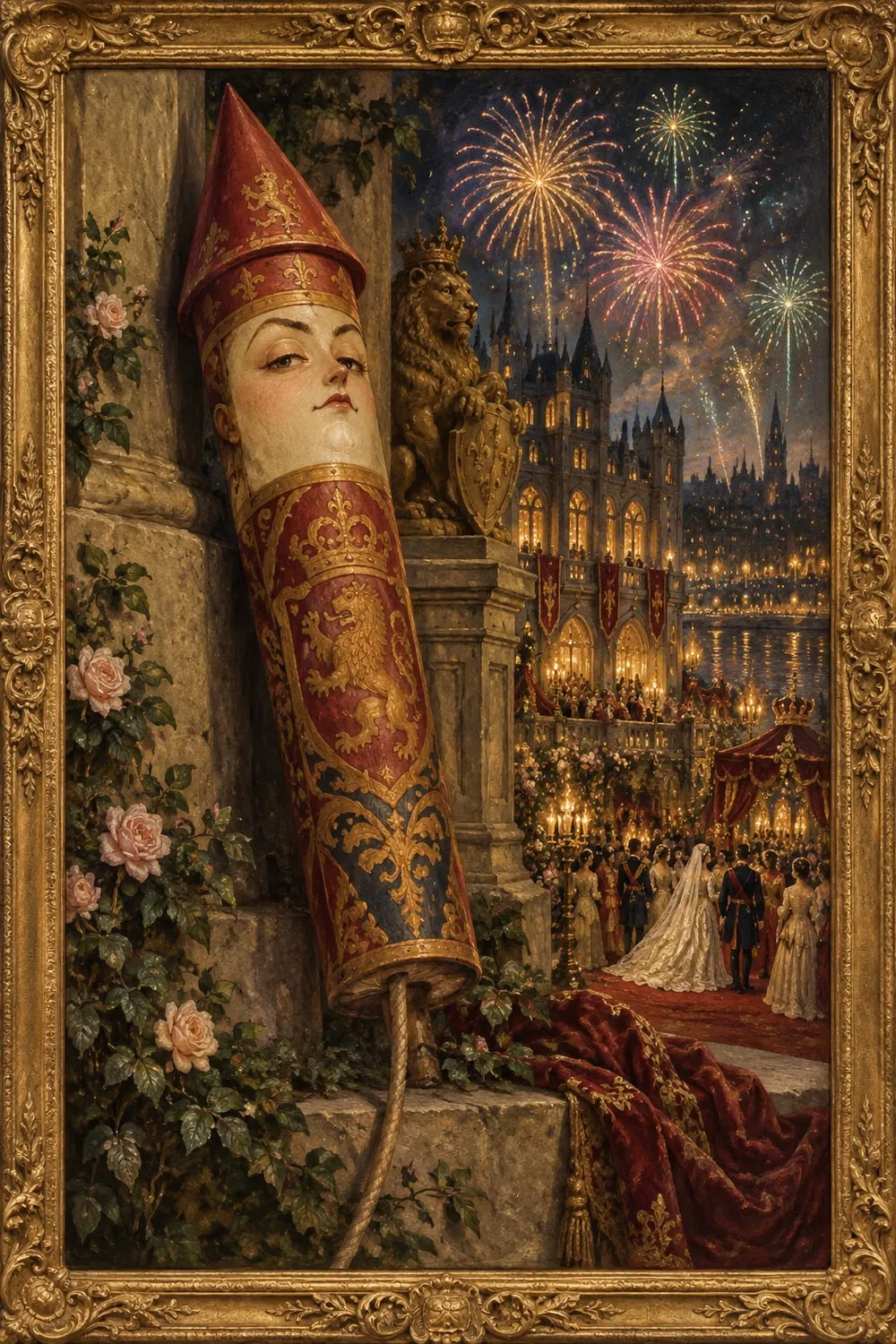
A royal wedding and a very conceited firework
The Remarkable Rocket
"I knew I should create a great sensation"
Fairy tale · The Happy Prince and Other Tales
Listen · 29 min
Read by Joy Chan for LibriVox. Public domain.
The King’s son was going to be married, so there were general rejoicings. He had waited a whole year for his bride, and at last she had arrived. She was a Russian Princess, and had driven all the way from Finland in a sledge drawn by six reindeer. The sledge was shaped like a great golden swan, and between the swan’s wings lay the little Princess herself. Her long ermine-cloak reached right down to her feet, on her head was a tiny cap of silver tissue, and she was as pale as the Snow Palace in which she had always lived. So pale was she that as she drove through the streets all the people wondered. “She is like a white rose!” they cried, and they threw down flowers on her from the balconies.
At the gate of the Castle the Prince was waiting to receive her. He had dreamy violet eyes, and his hair was like fine gold. When he saw her he sank upon one knee, and kissed her hand.
“Your picture was beautiful,” he murmured, “but you are more beautiful than your picture,” and the little Princess blushed.
“She was like a white rose before,” said a young Page to his neighbour, “but she is like a red rose now,” and the whole Court was delighted.
For the next three days everybody went about saying, “White rose, Red rose, Red rose, White rose,” and the King gave orders that the Page’s salary was to be doubled. As he received no salary at all this was not of much use to him, but it was considered a great honour, and was duly published in the Court Gazette.
When the three days were over the marriage was celebrated. It was a magnificent ceremony, and the bride and bridegroom walked hand in hand under a canopy of purple velvet embroidered with little pearls. Then there was a State Banquet, which lasted for five hours. The Prince and Princess sat at the top of the Great Hall and drank out of a cup of clear crystal. Only true lovers could drink out of this cup, for if false lips touched it, it grew grey and dull and cloudy.
“It’s quite clear that they love each other,” said the little Page, “as clear as crystal!” and the King doubled his salary a second time. “What an honour!” cried all the courtiers.
After the banquet there was to be a Ball. The bride and bridegroom were to dance the Rose-dance together, and the King had promised to play the flute. He played very badly, but no one had ever dared to tell him so, because he was the King. Indeed, he knew only two airs, and was never quite certain which one he was playing; but it made no matter, for, whatever he did, everybody cried out, “Charming! charming!”
The last item on the programme was a grand display of fireworks, to be let off exactly at midnight. The little Princess had never seen a firework in her life, so the King had given orders that the Royal Pyrotechnist should be in attendance on the day of her marriage.
“What are fireworks like?” she had asked the Prince, one morning, as she was walking on the terrace.
“They are like the Aurora Borealis,” said the King, who always answered questions that were addressed to other people, “only much more natural. I prefer them to stars myself, as you always know when they are going to appear, and they are as delightful as my own flute-playing. You must certainly see them.”
So at the end of the King’s garden a great stand had been set up, and as soon as the Royal Pyrotechnist had put everything in its proper place, the fireworks began to talk to each other.
“The world is certainly very beautiful,” cried a little Squib. “Just look at those yellow tulips. Why! if they were real crackers they could not be lovelier. I am very glad I have travelled. Travel improves the mind wonderfully, and does away with all one’s prejudices.”
“The King’s garden is not the world, you foolish squib,” said a big Roman Candle; “the world is an enormous place, and it would take you three days to see it thoroughly.”
“Any place you love is the world to you,” exclaimed a pensive Catherine Wheel, who had been attached to an old deal box in early life, and prided herself on her broken heart; “but love is not fashionable any more, the poets have killed it. They wrote so much about it that nobody believed them, and I am not surprised. True love suffers, and is silent. I remember myself once—But it is no matter now. Romance is a thing of the past.”
“Nonsense!” said the Roman Candle, “Romance never dies. It is like the moon, and lives forever. The bride and bridegroom, for instance, love each other very dearly. I heard all about them this morning from a brown-paper cartridge, who happened to be staying in the same drawer as myself, and knew the latest Court news.”
But the Catherine Wheel shook her head. “Romance is dead, Romance is dead, Romance is dead,” she murmured. She was one of those people who think that, if you say the same thing over and over a great many times, it becomes true in the end.
Suddenly, a sharp, dry cough was heard, and they all looked round.
It came from a tall, supercilious-looking Rocket, who was tied to the end of a long stick. He always coughed before he made any observation, so as to attract attention.
“Ahem! ahem!” he said, and everybody listened except the poor Catherine Wheel, who was still shaking her head, and murmuring, “Romance is dead.”
“Order! order!” cried out a Cracker. He was something of a politician, and had always taken a prominent part in the local elections, so he knew the proper Parliamentary expressions to use.
“Quite dead,” whispered the Catherine Wheel, and she went off to sleep.
As soon as there was perfect silence, the Rocket coughed a third time and began. He spoke with a very slow, distinct voice, as if he was dictating his memoirs, and always looked over the shoulder of the person to whom he was talking. In fact, he had a most distinguished manner.
“How fortunate it is for the King’s son,” he remarked, “that he is to be married on the very day on which I am to be let off. Really, if it had been arranged beforehand, it could not have turned out better for him; but, Princes are always lucky.”
“Dear me!” said the little Squib, “I thought it was quite the other way, and that we were to be let off in the Prince’s honour.”
“It may be so with you,” he answered; “indeed, I have no doubt that it is, but with me it is different. I am a very remarkable Rocket, and come of remarkable parents. My mother was the most celebrated Catherine Wheel of her day, and was renowned for her graceful dancing. When she made her great public appearance she spun round nineteen times before she went out, and each time that she did so she threw into the air seven pink stars. She was three feet and a half in diameter, and made of the very best gunpowder. My father was a Rocket like myself, and of French extraction. He flew so high that the people were afraid that he would never come down again. He did, though, for he was of a kindly disposition, and he made a most brilliant descent in a shower of golden rain. The newspapers wrote about his performance in very flattering terms. Indeed, the Court Gazette called him a triumph of Pylotechnic art.”
“Pyrotechnic, Pyrotechnic, you mean,” said a Bengal Light; “I know it is Pyrotechnic, for I saw it written on my own canister.”
“Well, I said Pylotechnic,” answered the Rocket, in a severe tone of voice, and the Bengal Light felt so crushed that he began at once to bully the little squibs, in order to show that he was still a person of some importance.
“I was saying,” continued the Rocket, “I was saying—What was I saying?”
“You were talking about yourself,” replied the Roman Candle.
“Of course; I knew I was discussing some interesting subject when I was so rudely interrupted. I hate rudeness and bad manners of every kind, for I am extremely sensitive. No one in the whole world is so sensitive as I am, I am quite sure of that.”
“What is a sensitive person?” said the Cracker to the Roman Candle.
“A person who, because he has corns himself, always treads on other people’s toes,” answered the Roman Candle in a low whisper; and the Cracker nearly exploded with laughter.
“Pray, what are you laughing at?” inquired the Rocket; “I am not laughing.”
“I am laughing because I am happy,” replied the Cracker.
“That is a very selfish reason,” said the Rocket angrily. “What right have you to be happy? You should be thinking about others. In fact, you should be thinking about me. I am always thinking about myself, and I expect everybody else to do the same. That is what is called sympathy. It is a beautiful virtue, and I possess it in a high degree. Suppose, for instance, anything happened to me tonight, what a misfortune that would be for everyone! The Prince and Princess would never be happy again, their whole married life would be spoiled; and as for the King, I know he would not get over it. Really, when I begin to reflect on the importance of my position, I am almost moved to tears.”
“If you want to give pleasure to others,” cried the Roman Candle, “you had better keep yourself dry.”
“Certainly,” exclaimed the Bengal Light, who was now in better spirits; “that is only common sense.”
“Common sense, indeed!” said the Rocket indignantly; “you forget that I am very uncommon, and very remarkable. Why, anybody can have common sense, provided that they have no imagination. But I have imagination, for I never think of things as they really are; I always think of them as being quite different. As for keeping myself dry, there is evidently no one here who can at all appreciate an emotional nature. Fortunately for myself, I don’t care. The only thing that sustains one through life is the consciousness of the immense inferiority of everybody else, and this is a feeling that I have always cultivated. But none of you have any hearts. Here you are laughing and making merry just as if the Prince and Princess had not just been married.”
“Well, really,” exclaimed a small Fire-balloon, “why not? It is a most joyful occasion, and when I soar up into the air I intend to tell the stars all about it. You will see them twinkle when I talk to them about the pretty bride.”
“Ah! what a trivial view of life!” said the Rocket; “but it is only what I expected. There is nothing in you; you are hollow and empty. Why, perhaps the Prince and Princess may go to live in a country where there is a deep river, and perhaps they may have one only son, a little fair-haired boy with violet eyes like the Prince himself; and perhaps some day he may go out to walk with his nurse; and perhaps the nurse may go to sleep under a great elder-tree; and perhaps the little boy may fall into the deep river and be drowned. What a terrible misfortune! Poor people, to lose their only son! It is really too dreadful! I shall never get over it.”
“But they have not lost their only son,” said the Roman Candle; “no misfortune has happened to them at all.”
“I never said that they had,” replied the Rocket; “I said that they might. If they had lost their only son there would be no use in saying anything more about the matter. I hate people who cry over spilt milk. But when I think that they might lose their only son, I certainly am very much affected.”
“You certainly are!” cried the Bengal Light. “In fact, you are the most affected person I ever met.”
“You are the rudest person I ever met,” said the Rocket, “and you cannot understand my friendship for the Prince.”
“Why, you don’t even know him,” growled the Roman Candle.
“I never said I knew him,” answered the Rocket. “I dare say that if I knew him I should not be his friend at all. It is a very dangerous thing to know one’s friends.”
“You had really better keep yourself dry,” said the Fire-balloon. “That is the important thing.”
“Very important for you, I have no doubt,” answered the Rocket, “but I shall weep if I choose,” and he actually burst into real tears, which flowed down his stick like raindrops, and nearly drowned two little beetles, who were just thinking of setting up house together, and were looking for a nice dry spot to live in.
“He must have a truly romantic nature,” said the Catherine Wheel, “for he weeps when there is nothing at all to weep about,” and she heaved a deep sigh, and thought about the deal box.
But the Roman Candle and the Bengal Light were quite indignant, and kept saying, “Humbug! humbug!” at the top of their voices. They were extremely practical, and whenever they objected to anything they called it humbug.
Then the moon rose like a wonderful silver shield; and the stars began to shine, and a sound of music came from the palace.
The Prince and Princess were leading the dance. They danced so beautifully that the tall white lilies peeped in at the window and watched them, and the great red poppies nodded their heads and beat time.
Then ten o’clock struck, and then eleven, and then twelve, and at the last stroke of midnight everyone came out on the terrace, and the King sent for the Royal Pyrotechnist.
“Let the fireworks begin,” said the King; and the Royal Pyrotechnist made a low bow, and marched down to the end of the garden. He had six attendants with him, each of whom carried a lighted torch at the end of a long pole.
It was certainly a magnificent display.
Whizz! Whizz! went the Catherine Wheel, as she spun round and round. Boom! Boom! went the Roman Candle. Then the Squibs danced all over the place, and the Bengal Lights made everything look scarlet. “Goodbye,” cried the Fire-balloon, as he soared away, dropping tiny blue sparks. Bang! Bang! answered the Crackers, who were enjoying themselves immensely. Every one was a great success except the Remarkable Rocket. He was so damp with crying that he could not go off at all. The best thing in him was the gunpowder, and that was so wet with tears that it was of no use. All his poor relations, to whom he would never speak, except with a sneer, shot up into the sky like wonderful golden flowers with blossoms of fire. Huzza! Huzza! cried the Court; and the little Princess laughed with pleasure.
“I suppose they are reserving me for some grand occasion,” said the Rocket; “no doubt that is what it means,” and he looked more supercilious than ever.
The next day the workmen came to put everything tidy. “This is evidently a deputation,” said the Rocket; “I will receive them with becoming dignity” so he put his nose in the air, and began to frown severely as if he were thinking about some very important subject. But they took no notice of him at all till they were just going away. Then one of them caught sight of him. “Hallo!” he cried, “what a bad rocket!” and he threw him over the wall into the ditch.
“Bad Rocket? Bad Rocket?” he said, as he whirled through the air; “impossible! Grand Rocket, that is what the man said. Bad and Grand sound very much the same, indeed they often are the same,” and he fell into the mud.
“It is not comfortable here,” he remarked, “but no doubt it is some fashionable watering-place, and they have sent me away to recruit my health. My nerves are certainly very much shattered, and I require rest.”
Then a little Frog, with bright jewelled eyes, and a green mottled coat, swam up to him.
“A new arrival, I see!” said the Frog. “Well, after all there is nothing like mud. Give me rainy weather and a ditch, and I am quite happy. Do you think it will be a wet afternoon? I am sure I hope so, but the sky is quite blue and cloudless. What a pity!”
“Ahem! ahem!” said the Rocket, and he began to cough.
“What a delightful voice you have!” cried the Frog. “Really it is quite like a croak, and croaking is of course the most musical sound in the world. You will hear our glee-club this evening. We sit in the old duck pond close by the farmer’s house, and as soon as the moon rises we begin. It is so entrancing that everybody lies awake to listen to us. In fact, it was only yesterday that I heard the farmer’s wife say to her mother that she could not get a wink of sleep at night on account of us. It is most gratifying to find oneself so popular.”
“Ahem! ahem!” said the Rocket angrily. He was very much annoyed that he could not get a word in.
“A delightful voice, certainly,” continued the Frog; “I hope you will come over to the duck-pond. I am off to look for my daughters. I have six beautiful daughters, and I am so afraid the Pike may meet them. He is a perfect monster, and would have no hesitation in breakfasting off them. Well, goodbye: I have enjoyed our conversation very much, I assure you.”
“Conversation, indeed!” said the Rocket. “You have talked the whole time yourself. That is not conversation.”
“Somebody must listen,” answered the Frog, “and I like to do all the talking myself. It saves time, and prevents arguments.”
“But I like arguments,” said the Rocket.
“I hope not,” said the Frog complacently. “Arguments are extremely vulgar, for everybody in good society holds exactly the same opinions. Goodbye a second time; I see my daughters in the distance,” and the little Frog swam away.
“You are a very irritating person,” said the Rocket, “and very ill-bred. I hate people who talk about themselves, as you do, when one wants to talk about oneself, as I do. It is what I call selfishness, and selfishness is a most detestable thing, especially to anyone of my temperament, for I am well known for my sympathetic nature. In fact, you should take example by me; you could not possibly have a better model. Now that you have the chance you had better avail yourself of it, for I am going back to Court almost immediately. I am a great favourite at Court; in fact, the Prince and Princess were married yesterday in my honour. Of course you know nothing of these matters, for you are a provincial.”
“There is no good talking to him,” said a Dragonfly, who was sitting on the top of a large brown bulrush; “no good at all, for he has gone away.”
“Well, that is his loss, not mine,” answered the Rocket. “I am not going to stop talking to him merely because he pays no attention. I like hearing myself talk. It is one of my greatest pleasures. I often have long conversations all by myself, and I am so clever that sometimes I don’t understand a single word of what I am saying.”
“Then you should certainly lecture on Philosophy,” said the Dragonfly; and he spread a pair of lovely gauze wings and soared away into the sky.
“How very silly of him not to stay here!” said the Rocket. “I am sure that he has not often got such a chance of improving his mind. However, I don’t care a bit. Genius like mine is sure to be appreciated some day,” and he sank down a little deeper into the mud.
After some time a large White Duck swam up to him. She had yellow legs, and webbed feet, and was considered a great beauty on account of her waddle.
“Quack, quack, quack,” she said. “What a curious shape you are! May I ask were you born like that, or is it the result of an accident?”
“It is quite evident that you have always lived in the country,” answered the Rocket, “otherwise you would know who I am. However, I excuse your ignorance. It would be unfair to expect other people to be as remarkable as oneself. You will no doubt be surprised to hear that I can fly up into the sky, and come down in a shower of golden rain.”
“I don’t think much of that,” said the Duck, “as I cannot see what use it is to anyone. Now, if you could plough the fields like the ox, or draw a cart like the horse, or look after the sheep like the collie-dog, that would be something.”
“My good creature,” cried the Rocket in a very haughty tone of voice, “I see that you belong to the lower orders. A person of my position is never useful. We have certain accomplishments, and that is more than sufficient. I have no sympathy myself with industry of any kind, least of all with such industries as you seem to recommend. Indeed, I have always been of opinion that hard work is simply the refuge of people who have nothing whatever to do.”
“Well, well,” said the Duck, who was of a very peaceable disposition, and never quarrelled with anyone, “everybody has different tastes. I hope, at any rate, that you are going to take up your residence here.”
“Oh! dear no,” cried the Rocket. “I am merely a visitor, a distinguished visitor. The fact is that I find this place rather tedious. There is neither society here, nor solitude. In fact, it is essentially suburban. I shall probably go back to Court, for I know that I am destined to make a sensation in the world.”
“I had thoughts of entering public life once myself,” remarked the Duck; “there are so many things that need reforming. Indeed, I took the chair at a meeting some time ago, and we passed resolutions condemning everything that we did not like. However, they did not seem to have much effect. Now I go in for domesticity, and look after my family.”
“I am made for public life,” said the Rocket, “and so are all my relations, even the humblest of them. Whenever we appear we excite great attention. I have not actually appeared myself, but when I do so it will be a magnificent sight. As for domesticity, it ages one rapidly, and distracts one’s mind from higher things.”
“Ah! the higher things of life, how fine they are!” said the Duck; “and that reminds me how hungry I feel,” and she swam away down the stream, saying, “Quack, quack, quack.”
“Come back! come back!” screamed the Rocket, “I have a great deal to say to you,” but the Duck paid no attention to him. “I am glad that she has gone,” he said to himself, “she has a decidedly middle-class mind,” and he sank a little deeper still into the mud, and began to think about the loneliness of genius, when suddenly two little boys in white smocks came running down the bank, with a kettle and some faggots.
“This must be the deputation,” said the Rocket, and he tried to look very dignified.
“Hallo!” cried one of the boys, “look at this old stick! I wonder how it came here,” and he picked the rocket out of the ditch.
“Old Stick!” said the Rocket, “impossible! Gold Stick, that is what he said. Gold Stick is very complimentary. In fact, he mistakes me for one of the Court dignitaries!”
“Let us put it into the fire!” said the other boy, “it will help to boil the kettle.”
So they piled the faggots together, and put the Rocket on top, and lit the fire.
“This is magnificent,” cried the Rocket, “they are going to let me off in broad daylight, so that everyone can see me.”
“We will go to sleep now,” they said, “and when we wake up the kettle will be boiled,” and they lay down on the grass, and shut their eyes.
The Rocket was very damp, so he took a long time to burn. At last, however, the fire caught him.
“Now I am going off!” he cried, and he made himself very stiff and straight. “I know I shall go much higher than the stars, much higher than the moon, much higher than the sun. In fact, I shall go so high that—”
Fizz! Fizz! Fizz! and he went straight up into the air.
“Delightful!” he cried, “I shall go on like this forever. What a success I am!”
But nobody saw him.
Then he began to feel a curious tingling sensation all over him.
“Now I am going to explode,” he cried. “I shall set the whole world on fire, and make such a noise that nobody will talk about anything else for a whole year.” And he certainly did explode. Bang! Bang! Bang! went the gunpowder. There was no doubt about it.
But nobody heard him, not even the two little boys, for they were sound asleep.
Then all that was left of him was the stick, and this fell down on the back of a Goose who was taking a walk by the side of the ditch.
“Good heavens!” cried the Goose. “It is going to rain sticks,” and she rushed into the water.
“I knew I should create a great sensation,” gasped the Rocket, and he went out.
The story in brief
SummaryThe King's son is marrying a pale Russian Princess who has come from Finland in a sledge shaped like a golden swan, and the celebrations are to end with fireworks at midnight. On a stand at the end of the King's garden the fireworks chat among themselves, until a tall, supercilious Rocket takes over. He announces that the Prince is lucky to be married on the day he is let off, talks at length of his remarkable parents and his own sensitive nature, and weeps real tears over a tragedy he has invented, though everyone tells him to keep dry.
At midnight every other firework goes up in splendour, but the Rocket is too damp with crying to go off. Next day a workman calls him a bad rocket and throws him into a ditch, where he lectures a Frog, a Dragonfly and a White Duck, each of whom leaves him talking to himself. Two boys find him, take him for an old stick and put him on their fire to boil a kettle, then fall asleep. He goes off at last in broad daylight, but nobody sees or hears him; his stick lands on a Goose, and he goes out sure that he has made a great sensation.
Key themes
"A person who, because he has corns himself, always treads on other people's toes"
Related works
Explore more of Wilde's writing The Devoted FriendLittle Hans gives everything to the rich Miller, who talks beautifully about friendship and gives nothing back. A water-rat and a linnet argue over the moral.Read more
  The Happy PrinceA gilded statue who can see all the misery of his city asks a swallow to strip him of his jewels and gold, one piece at a time, for the poor.Read more
  The Nightingale and the RoseA student needs a red rose to win a girl's hand, and a nightingale decides to make one for him from moonlight and her own heart's blood.Read more
 Summary
The King's son has waited a whole year for his bride, a Russian Princess as pale as the Snow Palace she has lived in, who drives from Finland in a golden swan-shaped sledge drawn by six reindeer. When the Prince tells her she is more beautiful than her picture she blushes, and a Page remarks that the white rose has become a red rose; the King doubles his salary, though he receives none. After the wedding comes a five-hour banquet, where the couple drink from a crystal cup that clouds at the touch of false lips, then a ball, with the King playing the flute badly, and at midnight a display of fireworks, because the Princess has never seen one.
In the King's garden the fireworks talk. A little Squib says travel improves the mind, a big Roman Candle talks sense, and a Catherine Wheel insists that Romance is dead. Then a tall Rocket coughs for attention. He says the Prince is lucky to marry on the day he is to be let off, describes his celebrated parents and claims to be the most sensitive person in the world. He scolds a Cracker for laughing simply because he is happy, declares that he is sustained by 'the consciousness of the immense inferiority of everybody else', and weeps over the drowning of a son the royal couple might one day have, soaking himself though the others beg him to keep dry.
At midnight the Royal Pyrotechnist lights the display. The Catherine Wheel spins, the Roman Candle booms, the Crackers bang and the Fire-balloon soars away, but the Rocket is so wet with tears that he cannot go off. He decides he is being reserved for some grand occasion. Next day a workman calls him a bad rocket and throws him over the wall into a ditch; he hears 'Grand Rocket' and supposes he has been sent to a fashionable watering-place to rest his nerves.
In the ditch a Frog talks without stopping and swims off, a Dragonfly suggests the Rocket should lecture on Philosophy, and a White Duck asks whether he was born that shape, then leaves when he tells her that a person of his position is never useful. Two boys in white smocks pick him out as an old stick, which he hears as 'Gold Stick', and put him on their fire to boil a kettle before falling asleep. When he finally goes off, sure he will fly higher than the sun, nobody sees or hears him. His stick falls on a Goose, who thinks it is going to rain sticks, and the Rocket goes out, gasping that he knew he would create a great sensation.
Characters
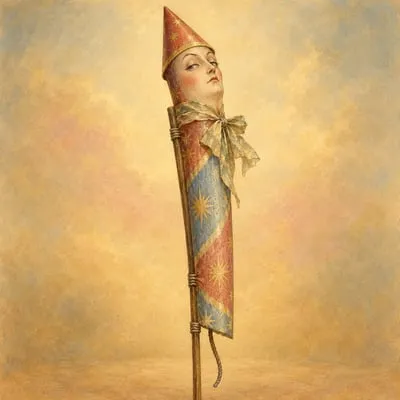
The Remarkable Rocket
Vanity on a stick
A tall, supercilious firework tied to a long stick, who coughs before every remark to attract attention and always looks over his listener's shoulder. He believes the royal wedding is held in his honour, is proud of his celebrated parents and his own sensitive nature, and weeps himself too damp to go off. Thrown into a ditch, then burned on two boys' fire, he explodes unnoticed and dies still sure of his success.
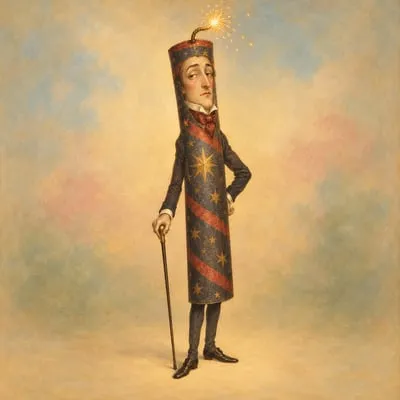
The Roman Candle
Plain common sense
A big firework who corrects the little Squib and tells the Catherine Wheel that Romance never dies. He punctures the Rocket's claims again and again: he defines a sensitive person as one who treads on other people's toes because he has corns himself, points out that the Rocket does not even know the Prince, and advises him to keep himself dry. He and the Bengal Light dismiss the Rocket's tears as humbug.

The Catherine Wheel
The romantic sufferer
A pensive firework who was attached to an old deal box in early life and prides herself on her broken heart. She keeps murmuring that Romance is dead, as though saying a thing often enough makes it true, and falls asleep during the Rocket's speech. She admires his tears as the sign of a truly romantic nature. At midnight she spins round and round with a whizz.
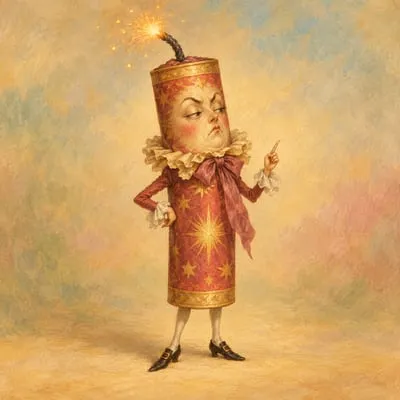
The Bengal Light
The small bully
A firework who corrects the Rocket's 'Pylotechnic' because he has seen the right word written on his own canister. Crushed by the Rocket's severe reply, he bullies the little squibs to show he is still a person of some importance. He recovers enough to agree that the Rocket should keep dry, and delivers the best retort of the evening: the Rocket is the most affected person he ever met.
The Cracker
The would-be politician
A firework who has taken a prominent part in local elections and so knows the proper Parliamentary expressions, calling 'Order! order!' when the Rocket wants silence. He nearly explodes with laughter at the Roman Candle's joke about sensitive people, and the Rocket scolds him for laughing simply because he is happy. At midnight the Crackers go off with a bang, enjoying themselves immensely.
The King
The flattered monarch
The bridegroom's father, who plays the flute very badly and knows only two tunes, but is always told 'Charming! charming!' because no one dares to say otherwise. He doubles the Page's non-existent salary twice, answers questions addressed to other people, and prefers fireworks to stars because you always know when they are going to appear. He orders the display for the Princess, who has never seen a firework.
The Prince and the Princess
The royal lovers
The King's son, with dreamy violet eyes and hair like fine gold, and his pale Russian bride, who drives from Finland in a sledge shaped like a golden swan. They love each other so truly that they can drink from the crystal cup that grows grey and cloudy at the touch of false lips. They lead the dance at the ball, and the Princess laughs with pleasure at the fireworks.
The little Page
The rewarded wit
A young courtier who remarks that the pale Princess, blushing, has changed from a white rose into a red rose, and later that the royal couple's love is as clear as crystal. Each time the King doubles his salary. This is not much use to him, since he receives no salary at all, but it is considered a great honour and published in the Court Gazette.
The Frog
Talker, not listener
A little Frog with bright jewelled eyes and a green mottled coat who welcomes the Rocket to the ditch. He loves mud and rain, is proud of his glee-club's croaking, which keeps the farmer's wife awake, and worries that the Pike will breakfast on his six daughters. He talks the whole time, explaining that it saves time and prevents arguments, and swims off before the Rocket can get a word in.
The White Duck
Practical good nature
A large White Duck, admired as a beauty on account of her waddle, who asks the Rocket whether he was born that shape. She sees no use in flying up in a shower of golden rain when he cannot plough or pull a cart. Once she chaired a meeting that condemned everything it did not like; now she goes in for domesticity. Peaceable by nature, she swims away when she feels hungry.
The two little boys
The indifferent audience
Two boys in white smocks who come down to the ditch with a kettle and some faggots. One picks the Rocket up as an old stick, and the other suggests putting it on the fire to help boil the kettle. They lie down on the grass and fall asleep, so that when the Rocket at last goes off, they neither see nor hear him.
Themes
Vanity
The Rocket believes the royal wedding revolves around him, and later tells the Frog that the Prince and Princess were married 'in my honour'. He defines sympathy as everyone thinking about him, sneers at his poor relations and treats every listener as a chance to talk about himself. The ending is the fullest statement of his vanity: he explodes unseen and unheard in broad daylight, his stick lands on a Goose, and he dies still believing that he has created a great sensation.
Self-deception
The Rocket never lets facts disturb his opinion of himself. He claims that his imagination lies in never thinking of things 'as they really are'. When he fails to go off, he decides he is being reserved for a grand occasion. The workmen become a 'deputation', 'bad rocket' becomes 'Grand Rocket', the ditch becomes a fashionable watering-place, and 'old stick' becomes 'Gold Stick', a Court dignitary. Each mishearing is a small comic proof that vanity can turn any humiliation into praise.
False feeling
The Rocket calls himself extremely sensitive, but his feeling is all for show. He weeps over a son the Prince and Princess do not have, drowned in a river that does not exist, and when the Roman Candle points this out he replies that he hates people who cry over spilt milk. The Bengal Light calls him 'the most affected person I ever met'. The Catherine Wheel, proud of her broken heart, is a gentler version of the same fault. And the tears are what ruin him: they soak his gunpowder.
Flattery at Court
The human world of the tale is a court where no one tells the truth. The King plays the flute badly, but because he is the King everyone cries 'Charming! charming!'. The Page's salary is doubled twice as an honour, though he receives no salary at all, and the King answers questions addressed to other people. This court of flatterers is mirrored on the fireworks' stand, where the Rocket expects the same deference and only the Roman Candle and the Bengal Light dare to call his behaviour 'Humbug!'.
Talking without listening
Nearly everyone in the tale loves the sound of their own voice. The Frog explains that 'Somebody must listen', but prefers to do all the talking himself, since it 'saves time, and prevents arguments'. The Rocket complains of this, then admits that he likes hearing himself talk so much that he sometimes does not understand a word he is saying. The White Duck once chaired a meeting that passed resolutions condemning everything it disliked. Conversation becomes a string of monologues, and the Rocket ends as he lived, talking to nobody.
Quotes
"I am always thinking about myself, and I expect everybody else to do the same. That is what is called sympathy."
The Remarkable Rocket
"The only thing that sustains one through life is the consciousness of the immense inferiority of everybody else, and this is a feeling that I have always cultivated."
The Remarkable Rocket
"A person who, because he has corns himself, always treads on other people's toes"
The Roman Candle
"It is a very dangerous thing to know one's friends."
The Remarkable Rocket
"hard work is simply the refuge of people who have nothing whatever to do"
The Remarkable Rocket
Context
The Remarkable Rocket is one of the five stories in The Happy Prince and Other Tales, published by David Nutt in May 1888 with illustrations by Walter Crane and Jacomb Hood. Like The Devoted Friend, it is a comic tale with no miracle at its end, in which talking animals and objects show up human vanity and a self-satisfied character learns nothing.
The tale is a comedy of manners in which fireworks, a frog and a duck speak like members of polite society. The Rocket's phrases, 'a person of my position', 'the lower orders', 'a decidedly middle-class mind', are the snobbish talk of a drawing-room, and the Court he admires is one where the King's bad flute-playing is always charming. The love story of the Prince and Princess is told quickly and happily; the tale's real subject is the Rocket's belief that he is its hero.
About this edition
- Text: the complete work from Standard Ebooks, released into the public domain (CC0 1.0). We change only the layout.
- Download the EPUB of the whole book it comes from, free, for any e-reader.
- Audiobook: read by Joy Chan for LibriVox, in the public domain.
- Every quotation and glossary word in these notes is checked against the text.