A statue, a swallow and the cost of pity
The Happy Prince
"There is no Mystery so great as Misery."
Fairy tale · The Happy Prince and Other Tales
Listen · 22 min
Read by Joy Chan for LibriVox. Public domain.
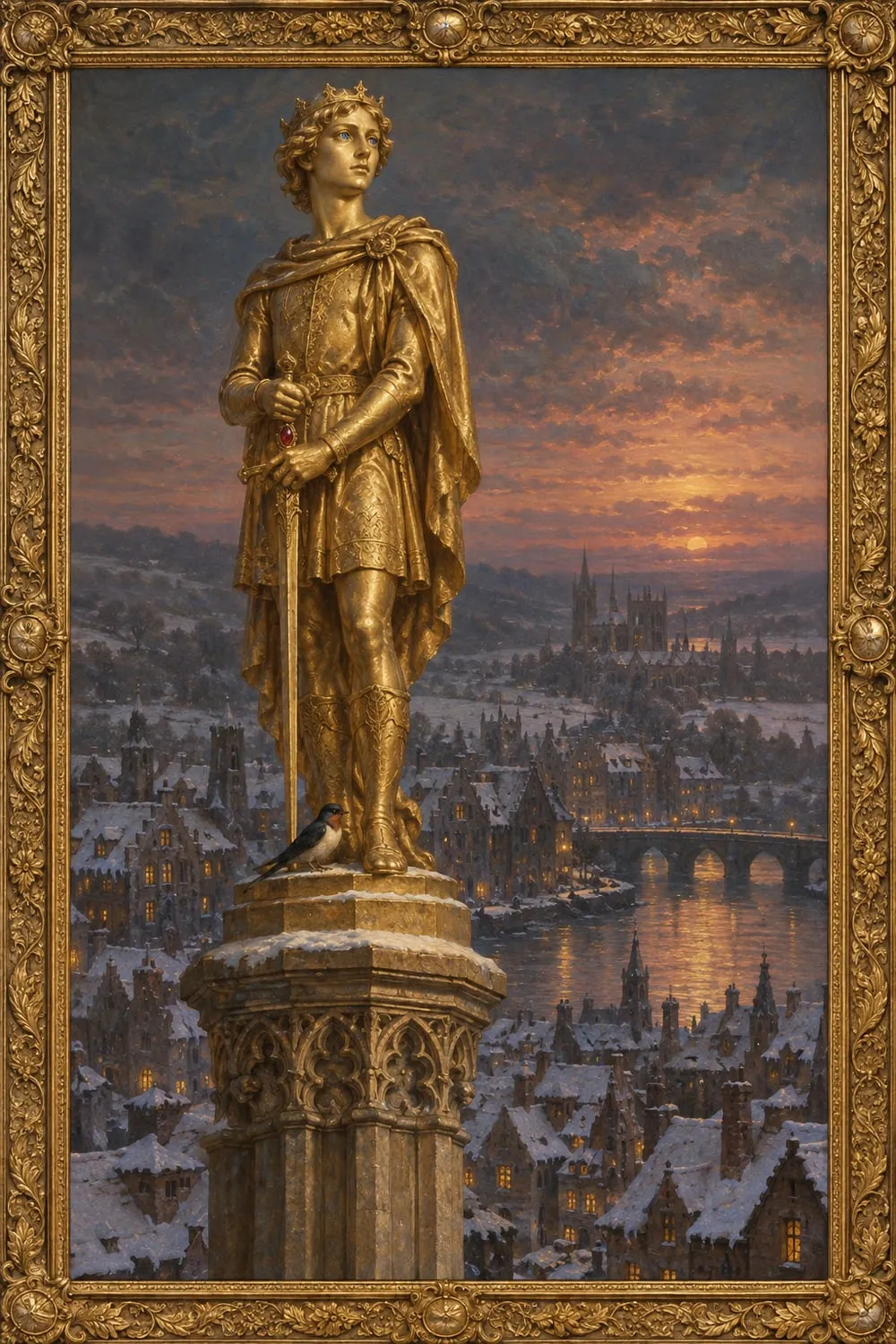
High above the city, on a tall column, stood the statue of the Happy Prince. He was gilded all over with thin leaves of fine gold, for eyes he had two bright sapphires, and a large red ruby glowed on his sword-hilt.
He was very much admired indeed. “He is as beautiful as a weathercock,” remarked one of the Town Councillors who wished to gain a reputation for having artistic tastes; “only not quite so useful,” he added, fearing lest people should think him unpractical, which he really was not.
“Why can’t you be like the Happy Prince?” asked a sensible mother of her little boy who was crying for the moon. “The Happy Prince never dreams of crying for anything.”
“I am glad there is someone in the world who is quite happy,” muttered a disappointed man as he gazed at the wonderful statue.
“He looks just like an angel,” said the Charity Children as they came out of the cathedral in their bright scarlet cloaks and their clean white pinafores.
“How do you know?” said the Mathematical Master, “you have never seen one.”
“Ah! but we have, in our dreams,” answered the children; and the Mathematical Master frowned and looked very severe, for he did not approve of children dreaming.
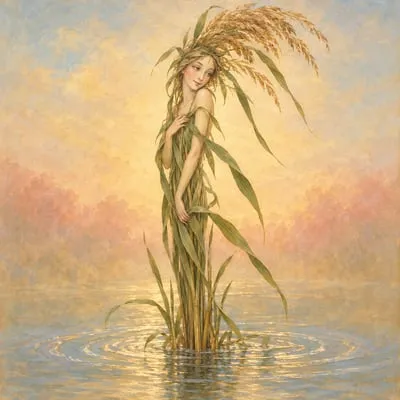
One night there flew over the city a little Swallow. His friends had gone away to Egypt six weeks before, but he had stayed behind, for he was in love with the most beautiful Reed. He had met her early in the spring as he was flying down the river after a big yellow moth, and had been so attracted by her slender waist that he had stopped to talk to her.
“Shall I love you?” said the Swallow, who liked to come to the point at once, and the Reed made him a low bow. So he flew round and round her, touching the water with his wings, and making silver ripples. This was his courtship, and it lasted all through the summer.
“It is a ridiculous attachment,” twittered the other Swallows; “she has no money, and far too many relations,” and indeed the river was quite full of Reeds. Then, when the autumn came they all flew away.
After they had gone he felt lonely, and began to tire of his ladylove. “She has no conversation,” he said, “and I am afraid that she is a coquette, for she is always flirting with the wind.” And certainly, whenever the wind blew, the Reed made the most graceful curtseys. “I admit that she is domestic,” he continued, “but I love travelling, and my wife, consequently, should love travelling also.”
“Will you come away with me?” he said finally to her; but the Reed shook her head, she was so attached to her home.
“You have been trifling with me,” he cried. “I am off to the Pyramids. Goodbye!” and he flew away.
All day long he flew, and at nighttime he arrived at the city. “Where shall I put up?” he said; “I hope the town has made preparations.”
Then he saw the statue on the tall column.
“I will put up there,” he cried; “it is a fine position, with plenty of fresh air.” So he alighted just between the feet of the Happy Prince.
“I have a golden bedroom,” he said softly to himself as he looked round, and he prepared to go to sleep; but just as he was putting his head under his wing a large drop of water fell on him. “What a curious thing!” he cried; “there is not a single cloud in the sky, the stars are quite clear and bright, and yet it is raining. The climate in the north of Europe is really dreadful. The Reed used to like the rain, but that was merely her selfishness.”
Then another drop fell.
“What is the use of a statue if it cannot keep the rain off?” he said; “I must look for a good chimney-pot,” and he determined to fly away.
But before he had opened his wings, a third drop fell, and he looked up, and saw—Ah! what did he see?
The eyes of the Happy Prince were filled with tears, and tears were running down his golden cheeks. His face was so beautiful in the moonlight that the little Swallow was filled with pity.
“Who are you?” he said.
“I am the Happy Prince.”
“Why are you weeping then?” asked the Swallow; “you have quite drenched me.”
“When I was alive and had a human heart,” answered the statue, “I did not know what tears were, for I lived in the Palace of Sans-Souci, where sorrow is not allowed to enter. In the daytime I played with my companions in the garden, and in the evening I led the dance in the Great Hall. Round the garden ran a very lofty wall, but I never cared to ask what lay beyond it, everything about me was so beautiful. My courtiers called me the Happy Prince, and happy indeed I was, if pleasure be happiness. So I lived, and so I died. And now that I am dead they have set me up here so high that I can see all the ugliness and all the misery of my city, and though my heart is made of lead yet I cannot chose but weep.”
“What! is he not solid gold?” said the Swallow to himself. He was too polite to make any personal remarks out loud.
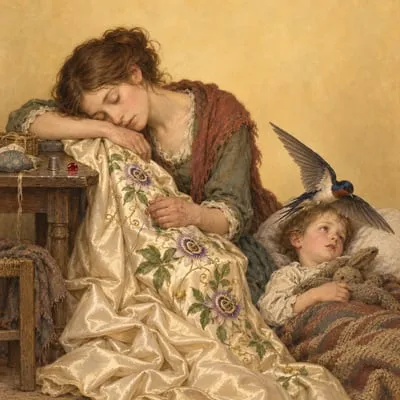
“Far away,” continued the statue in a low musical voice, “far away in a little street there is a poor house. One of the windows is open, and through it I can see a woman seated at a table. Her face is thin and worn, and she has coarse, red hands, all pricked by the needle, for she is a seamstress. She is embroidering passionflowers on a satin gown for the loveliest of the Queen’s maids-of-honour to wear at the next Court-ball. In a bed in the corner of the room her little boy is lying ill. He has a fever, and is asking for oranges. His mother has nothing to give him but river water, so he is crying. Swallow, Swallow, little Swallow, will you not bring her the ruby out of my sword-hilt? My feet are fastened to this pedestal and I cannot move.”
“I am waited for in Egypt,” said the Swallow. “My friends are flying up and down the Nile, and talking to the large lotus-flowers. Soon they will go to sleep in the tomb of the great King. The King is there himself in his painted coffin. He is wrapped in yellow linen, and embalmed with spices. Round his neck is a chain of pale green jade, and his hands are like withered leaves.”
“Swallow, Swallow, little Swallow,” said the Prince, “will you not stay with me for one night, and be my messenger? The boy is so thirsty, and the mother so sad.”
“I don’t think I like boys,” answered the Swallow. “Last summer, when I was staying on the river, there were two rude boys, the miller’s sons, who were always throwing stones at me. They never hit me, of course; we swallows fly far too well for that, and besides, I come of a family famous for its agility; but still, it was a mark of disrespect.”
But the Happy Prince looked so sad that the little Swallow was sorry. “It is very cold here,” he said; “but I will stay with you for one night, and be your messenger.”
“Thank you, little Swallow,” said the Prince.
So the Swallow picked out the great ruby from the Prince’s sword, and flew away with it in his beak over the roofs of the town.
He passed by the cathedral tower, where the white marble angels were sculptured. He passed by the palace and heard the sound of dancing. A beautiful girl came out on the balcony with her lover. “How wonderful the stars are,” he said to her, “and how wonderful is the power of love!”
“I hope my dress will be ready in time for the State-ball,” she answered; “I have ordered passionflowers to be embroidered on it; but the seamstresses are so lazy.”
He passed over the river, and saw the lanterns hanging to the masts of the ships. He passed over the Ghetto, and saw the old Jews bargaining with each other, and weighing out money in copper scales. At last he came to the poor house and looked in. The boy was tossing feverishly on his bed, and the mother had fallen asleep, she was so tired. In he hopped, and laid the great ruby on the table beside the woman’s thimble. Then he flew gently round the bed, fanning the boy’s forehead with his wings. “How cool I feel,” said the boy, “I must be getting better,” and he sank into a delicious slumber.
Then the Swallow flew back to the Happy Prince, and told him what he had done. “It is curious,” he remarked, “but I feel quite warm now, although it is so cold.”
“That is because you have done a good action,” said the Prince. And the little Swallow began to think, and then he fell asleep. Thinking always made him sleepy.
When day broke he flew down to the river and had a bath. “What a remarkable phenomenon,” said the Professor of Ornithology as he was passing over the bridge. “A swallow in winter!” And he wrote a long letter about it to the local newspaper. Everyone quoted it, it was full of so many words that they could not understand.
“Tonight I go to Egypt,” said the Swallow, and he was in high spirits at the prospect. He visited all the public monuments, and sat a long time on top of the church steeple. Wherever he went the Sparrows chirruped, and said to each other, “What a distinguished stranger!” so he enjoyed himself very much.
When the moon rose he flew back to the Happy Prince. “Have you any commissions for Egypt?” he cried; “I am just starting.”
“Swallow, Swallow, little Swallow,” said the Prince, “will you not stay with me one night longer?”
“I am waited for in Egypt,” answered the Swallow. “Tomorrow my friends will fly up to the Second Cataract. The river-horse couches there among the bulrushes, and on a great granite throne sits the God Memnon. All night long he watches the stars, and when the morning star shines he utters one cry of joy, and then he is silent. At noon the yellow lions come down to the water’s edge to drink. They have eyes like green beryls, and their roar is louder than the roar of the cataract.”
“Swallow, Swallow, little Swallow,” said the Prince, “far away across the city I see a young man in a garret. He is leaning over a desk covered with papers, and in a tumbler by his side there is a bunch of withered violets. His hair is brown and crisp, and his lips are red as a pomegranate, and he has large and dreamy eyes. He is trying to finish a play for the Director of the Theatre, but he is too cold to write any more. There is no fire in the grate, and hunger has made him faint.”
“I will wait with you one night longer,” said the Swallow, who really had a good heart. “Shall I take him another ruby?”
“Alas! I have no ruby now,” said the Prince; “my eyes are all that I have left. They are made of rare sapphires, which were brought out of India a thousand years ago. Pluck out one of them and take it to him. He will sell it to the jeweller, and buy food and firewood, and finish his play.”
“Dear Prince,” said the Swallow, “I cannot do that,” and he began to weep.
“Swallow, Swallow, little Swallow,” said the Prince, “do as I command you.”
So the Swallow plucked out the Prince’s eye, and flew away to the student’s garret. It was easy enough to get in, as there was a hole in the roof. Through this he darted, and came into the room. The young man had his head buried in his hands, so he did not hear the flutter of the bird’s wings, and when he looked up he found the beautiful sapphire lying on the withered violets.
“I am beginning to be appreciated,” he cried; “this is from some great admirer. Now I can finish my play,” and he looked quite happy.
The next day the Swallow flew down to the harbour. He sat on the mast of a large vessel and watched the sailors hauling big chests out of the hold with ropes. “Heave a-hoy!” they shouted as each chest came up. “I am going to Egypt!” cried the Swallow, but nobody minded, and when the moon rose he flew back to the Happy Prince.
“I am come to bid you goodbye,” he cried.
“Swallow, Swallow, little Swallow,” said the Prince, “will you not stay with me one night longer?”
“It is winter,” answered the Swallow, “and the chill snow will soon be here. In Egypt the sun is warm on the green palm-trees, and the crocodiles lie in the mud and look lazily about them. My companions are building a nest in the Temple of Baalbec, and the pink and white doves are watching them, and cooing to each other. Dear Prince, I must leave you, but I will never forget you, and next spring I will bring you back two beautiful jewels in place of those you have given away. The ruby shall be redder than a red rose, and the sapphire shall be as blue as the great sea.”
“In the square below,” said the Happy Prince, “there stands a little match-girl. She has let her matches fall in the gutter, and they are all spoiled. Her father will beat her if she does not bring home some money, and she is crying. She has no shoes or stockings, and her little head is bare. Pluck out my other eye, and give it to her, and her father will not beat her.”
“I will stay with you one night longer,” said the Swallow, “but I cannot pluck out your eye. You would be quite blind then.”
“Swallow, Swallow, little Swallow,” said the Prince, “do as I command you.”
So he plucked out the Prince’s other eye, and darted down with it. He swooped past the match-girl, and slipped the jewel into the palm of her hand. “What a lovely bit of glass,” cried the little girl; and she ran home, laughing.
Then the Swallow came back to the Prince. “You are blind now,” he said, “so I will stay with you always.”
“No, little Swallow,” said the poor Prince, “you must go away to Egypt.”
“I will stay with you always,” said the Swallow, and he slept at the Prince’s feet.
All the next day he sat on the Prince’s shoulder, and told him stories of what he had seen in strange lands. He told him of the red ibises, who stand in long rows on the banks of the Nile, and catch goldfish in their beaks; of the Sphinx, who is as old as the world itself, and lives in the desert, and knows everything; of the merchants, who walk slowly by the side of their camels, and carry amber beads in their hands; of the King of the Mountains of the Moon, who is as black as ebony, and worships a large crystal; of the great green snake that sleeps in a palm-tree, and has twenty priests to feed it with honey-cakes; and of the pygmies who sail over a big lake on large flat leaves, and are always at war with the butterflies.
“Dear little Swallow,” said the Prince, “you tell me of marvellous things, but more marvellous than anything is the suffering of men and of women. There is no Mystery so great as Misery. Fly over my city, little Swallow, and tell me what you see there.”
So the Swallow flew over the great city, and saw the rich making merry in their beautiful houses, while the beggars were sitting at the gates. He flew into dark lanes, and saw the white faces of starving children looking out listlessly at the black streets. Under the archway of a bridge two little boys were lying in one another’s arms to try and keep themselves warm. “How hungry we are!” they said. “You must not lie here,” shouted the Watchman, and they wandered out into the rain.
Then he flew back and told the Prince what he had seen.
“I am covered with fine gold,” said the Prince, “you must take it off, leaf by leaf, and give it to my poor; the living always think that gold can make them happy.”
Leaf after leaf of the fine gold the Swallow picked off, till the Happy Prince looked quite dull and grey. Leaf after leaf of the fine gold he brought to the poor, and the children’s faces grew rosier, and they laughed and played games in the street. “We have bread now!” they cried.
Then the snow came, and after the snow came the frost. The streets looked as if they were made of silver, they were so bright and glistening; long icicles like crystal daggers hung down from the eaves of the houses, everybody went about in furs, and the little boys wore scarlet caps and skated on the ice.
The poor little Swallow grew colder and colder, but he would not leave the Prince, he loved him too well. He picked up crumbs outside the baker’s door when the baker was not looking and tried to keep himself warm by flapping his wings.
But at last he knew that he was going to die. He had just strength to fly up to the Prince’s shoulder once more. “Goodbye, dear Prince!” he murmured, “will you let me kiss your hand?”
“I am glad that you are going to Egypt at last, little Swallow,” said the Prince, “you have stayed too long here; but you must kiss me on the lips, for I love you.”
“It is not to Egypt that I am going,” said the Swallow. “I am going to the House of Death. Death is the brother of Sleep, is he not?”
And he kissed the Happy Prince on the lips, and fell down dead at his feet.
At that moment a curious crack sounded inside the statue, as if something had broken. The fact is that the leaden heart had snapped right in two. It certainly was a dreadfully hard frost.
Early the next morning the Mayor was walking in the square below in company with the Town Councillors. As they passed the column he looked up at the statue: “Dear me! how shabby the Happy Prince looks!” he said.
“How shabby indeed!” cried the Town Councillors, who always agreed with the Mayor; and they went up to look at it.
“The ruby has fallen out of his sword, his eyes are gone, and he is golden no longer,” said the Mayor; “in fact, he is little better than a beggar!”
“Little better than a beggar,” said the Town Councillors.
“And here is actually a dead bird at his feet!” continued the Mayor. “We must really issue a proclamation that birds are not to be allowed to die here.” And the Town Clerk made a note of the suggestion.
So they pulled down the statue of the Happy Prince. “As he is no longer beautiful he is no longer useful,” said the Art Professor at the University.
Then they melted the statue in a furnace, and the Mayor held a meeting of the Corporation to decide what was to be done with the metal. “We must have another statue, of course,” he said, “and it shall be a statue of myself.”
“Of myself,” said each of the Town Councillors, and they quarrelled. When I last heard of them they were quarrelling still.
“What a strange thing!” said the overseer of the workmen at the foundry. “This broken lead heart will not melt in the furnace. We must throw it away.” So they threw it on a dust-heap where the dead Swallow was also lying.
“Bring me the two most precious things in the city,” said God to one of His Angels; and the Angel brought Him the leaden heart and the dead bird.
“You have rightly chosen,” said God, “for in my garden of Paradise this little bird shall sing forevermore, and in my city of gold the Happy Prince shall praise me.”
The story in brief
AI-assisted summaryThe gilded statue of the Happy Prince stands on a tall column above a city, with two sapphires for eyes and a large ruby on his sword-hilt. In life the Prince lived in the Palace of Sans-Souci, where sorrow was not allowed to enter, and never asked what lay beyond its wall. Now, set up high, he can see all the misery of his city, and though his heart is made of lead he weeps. A little Swallow, late for Egypt after a summer spent courting a Reed, shelters between the statue's feet, and the Prince asks him to stay one night and be his messenger.
One night becomes many. The Swallow carries the ruby to a poor seamstress with a sick son, one sapphire to a starving young playwright and the other to a match-girl, then strips off the Prince's gold leaf for the city's poor. Winter comes, and the Swallow, who will not leave the now blind Prince, dies at his feet; the leaden heart snaps in two. The Mayor and Town Councillors pull down the shabby statue and melt it, but the broken heart will not melt. When God asks for the two most precious things in the city, His Angel brings the heart and the dead bird.
Key themes
"He is as beautiful as a weathercock"
Related works
Explore more of Wilde's writing The Devoted FriendLittle Hans gives everything to the rich Miller, who talks beautifully about friendship and gives nothing back. A water-rat and a linnet argue over the moral.Read more
  The Nightingale and the RoseA student needs a red rose to win a girl's hand, and a nightingale decides to make one for him from moonlight and her own heart's blood.Read more
  The Remarkable RocketA firework at a royal wedding is so full of his own importance that he misses the celebration entirely. Wilde's funniest portrait of vanity.Read more
 Summary
AI-assisted summaryThe statue of the Happy Prince stands high above the city, covered in gold leaf, with sapphire eyes and a ruby in his sword-hilt, and everyone admires him: a Town Councillor calls him as beautiful as a weathercock, a mother holds him up as a model to her crying son, and the Charity Children say he looks like an angel. One night a Swallow arrives. His friends left for Egypt six weeks ago, but he stayed behind for love of a Reed, then tired of her because she had no conversation and would not travel. He settles between the statue's feet and is soaked by drops falling from a clear sky: the Prince is weeping.
The Prince explains that he lived a life of pleasure in the Palace of Sans-Souci and now sees all the ugliness and misery of his city. He asks the Swallow to take the ruby to a seamstress who is embroidering passionflowers on a gown for a maid-of-honour while her feverish boy cries for oranges. The Swallow agrees to stay one night, lays the ruby beside her thimble and fans the boy's forehead, and afterwards feels strangely warm, because, the Prince tells him, he has done a good action. On the following nights the Prince has him pluck out both sapphire eyes. One goes to a young man in a garret, too cold and hungry to finish his play, who thinks it comes from an admirer; the other goes to a little match-girl whose father will beat her for losing her matches.
Now that the Prince is blind, the Swallow refuses to leave him. He tells him stories of the Nile and the Sphinx, but the Prince says that the suffering of men and women is more marvellous than anything, and sends him to look at the city. The Swallow sees the rich making merry while beggars sit at their gates and starving children stare into the black streets. On the Prince's orders he strips off the fine gold, leaf by leaf, and gives it to the poor, until the statue is dull and grey. Then the snow and frost come. Knowing he is dying, the Swallow kisses the Prince on the lips and falls dead at his feet, and the leaden heart cracks in two.
Next morning the Mayor finds the statue little better than a beggar, and the Town Councillors agree. They pull it down, the Art Professor declaring that since it is no longer beautiful it is no longer useful, and melt it in a furnace; the Councillors then quarrel over whose statue should replace it. The broken lead heart will not melt, so it is thrown on a dust-heap beside the dead Swallow. God asks one of His Angels for the two most precious things in the city, and the Angel brings the heart and the bird, which God receives into Paradise.
Characters
AI-assisted notes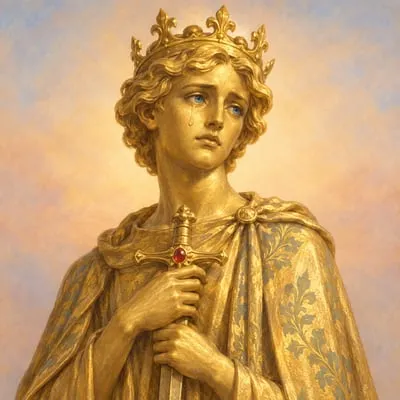
The Happy Prince
Pity learned after death
A dead prince whose gilded statue, with sapphire eyes and a ruby on its sword-hilt, stands above the city. In life he knew only pleasure behind the walls of Sans-Souci; as a statue he sees the city's misery and weeps with a heart of lead. Fixed to his pedestal, he gives away his ruby, his eyes and his gold through the Swallow until he is blind and grey, and his broken heart is chosen by God.
The Swallow
Messenger and devoted friend
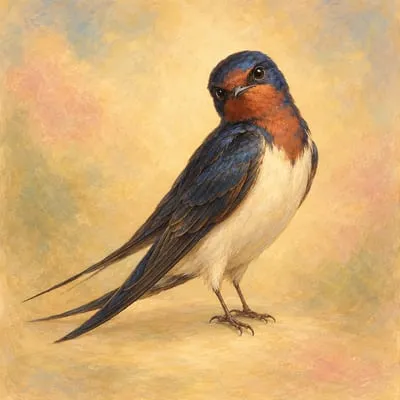
A little bird who stays behind when his friends fly to Egypt because he has fallen for a Reed, then leaves her in a huff. Vain, chatty and easily bored at first, he agrees to stay one night as the Prince's messenger, and then another, until he gives up Egypt altogether. He carries every gift, tells the blind Prince stories of the Nile, and dies of cold at his feet after kissing him on the lips.
The Reed
The Swallow's first love
A slender river Reed whom the Swallow courts all summer by flying round her and making silver ripples on the water. The other Swallows call it a ridiculous attachment, since she has no money and far too many relations. She will not leave her home to travel, and the Swallow accuses her of flirting with the wind. Her story sets up the shallow love that his love for the Prince replaces.
The seamstress and her son
Poverty at the needle
A tired woman with coarse, needle-pricked hands who embroiders passionflowers on a satin gown for one of the Queen's maids-of-honour, while her little boy lies ill with fever, asking for oranges she cannot buy. The Swallow leaves the ruby beside her thimble as she sleeps and cools the boy with his wings. Her story answers the rich girl on the palace balcony who complains that seamstresses are so lazy.
The young man in the garret
The starving writer
A young man with crisp brown hair and dreamy eyes who is trying to finish a play for the Director of the Theatre, but is too cold and faint with hunger to go on. The Swallow drops the Prince's first sapphire through a hole in his roof onto a bunch of withered violets. He takes it as a present from some great admirer and declares that he is beginning to be appreciated.
The little match-girl
A child in the square
A barefoot, bareheaded girl in the square below the statue who has let her matches fall into the gutter and is crying because her father will beat her if she brings home no money. The Prince gives her his second sapphire, which leaves him blind. She takes the jewel for a lovely bit of glass and runs home laughing.
The Mayor and Town Councillors
Civic self-importance
The city's rulers, who admire the statue only while it glitters. The Mayor finds it little better than a beggar once its gold is gone, wants a proclamation forbidding birds to die in the square, and proposes a new statue of himself. The Councillors echo every word he says until each of them wants his own statue, and they fall to quarrelling. The Art Professor and the Town Clerk complete this picture of official folly.
God and His Angel
The true judge of worth
They appear only in the closing lines. God asks one of His Angels to bring Him the two most precious things in the city, and the Angel returns with the broken leaden heart and the dead Swallow from the dust-heap. God approves the choice, promising that the bird will sing forever in His garden of Paradise and that the Happy Prince will praise Him in His city of gold.
Themes
AI-assisted notesPleasure and blindness to suffering
In life the Prince was happy only because he never looked. He lived in the Palace of Sans-Souci, 'where sorrow is not allowed to enter', and never cared to ask what lay beyond its lofty wall. Death reverses this. Raised on his column, he sees the seamstress, the young playwright and the match-girl, and learns from the Swallow of starving children in dark lanes, and he cannot stop weeping. His name becomes ironic, and his words to the Swallow, 'There is no Mystery so great as Misery', show that his earlier happiness depended on not seeing.
Love and self-sacrifice
Both the Prince and the Swallow give themselves away piece by piece. The Prince surrenders his ruby, then his eyes, then his gold, until he is blind and grey. The Swallow begins as a vain, flighty lover who drops the Reed because she has 'no conversation', but each night he postpones Egypt a little longer until he chooses to stay 'always'. His death at the Prince's feet, after a kiss on the lips, and the leaden heart that snaps at that moment, make their friendship the emotional centre of the tale.
Civic vanity
The city's officials care only for appearances. A Town Councillor praises the statue as 'as beautiful as a weathercock', then worries about seeming unpractical. The Mayor proposes a proclamation forbidding birds to die in the square, the Art Professor declares that the statue is no longer useful because it is no longer beautiful, and each Councillor wants the melted metal made into a statue of himself. The narrator leaves them 'quarrelling still', a sharp picture of public men who see nothing of the misery the statue saw.
True and false value
To the city the statue's worth lies in its gold, its sapphires and its ruby, yet its heart is only lead, and the Swallow is surprised to find it is not solid gold. Stripped of every precious thing, the statue is judged worthless and melted down. God reverses the city's judgement: asked for the two most precious things in the city, the Angel brings the broken leaden heart and the dead bird from the dust-heap. What mattered was never the gold but the love that gave it away.
Charity that goes unseen
None of the people the Prince helps knows where the gifts come from. The seamstress sleeps through the Swallow's visit, the young playwright believes his sapphire comes from 'some great admirer', and the match-girl runs home laughing at 'a lovely bit of glass'. The Prince seeks no thanks and gets none. His remark that 'the living always think that gold can make them happy' cuts both ways: the gold does feed the children, but the tale values the giving, and the love behind it, above anything the gold can buy.
Quotes
"He is as beautiful as a weathercock"
A Town Councillor
"I am going to the House of Death. Death is the brother of Sleep, is he not?"
The Swallow
"the living always think that gold can make them happy"
The Happy Prince
"As he is no longer beautiful he is no longer useful"
The Art Professor
"Bring me the two most precious things in the city"
God
Context
AI-assisted notesThe Happy Prince is the title story of The Happy Prince and Other Tales, which David Nutt published in May 1888 with illustrations by Walter Crane and Jacomb Hood. It was Wilde's first book of fairy tales; its companions are The Nightingale and the Rose, The Selfish Giant, The Devoted Friend and The Remarkable Rocket. A second collection, A House of Pomegranates, followed in 1891.
The tale works on two levels at once. It has the pattern of a nursery story, with the Prince's repeated plea, 'Swallow, Swallow, little Swallow', and a bird who postpones his journey one night at a time. It is also a satire on a city run by self-important men: a Mathematical Master who disapproves of children dreaming, a Professor of Ornithology whose letter to the newspaper is full of words nobody understands, and a Mayor who wants a statue of himself. The narrator even steps forward to report that the Councillors are quarrelling still.
About this edition
- Text: the complete work from Standard Ebooks, released into the public domain (CC0 1.0). We change only the layout.
- Download the EPUB of the whole book it comes from, free, for any e-reader.
- Audiobook: read by Joy Chan for LibriVox, in the public domain.
- The summaries, character notes, themes and glossary were written with AI from the text and then checked: every quotation and every glossary word is matched against the text.