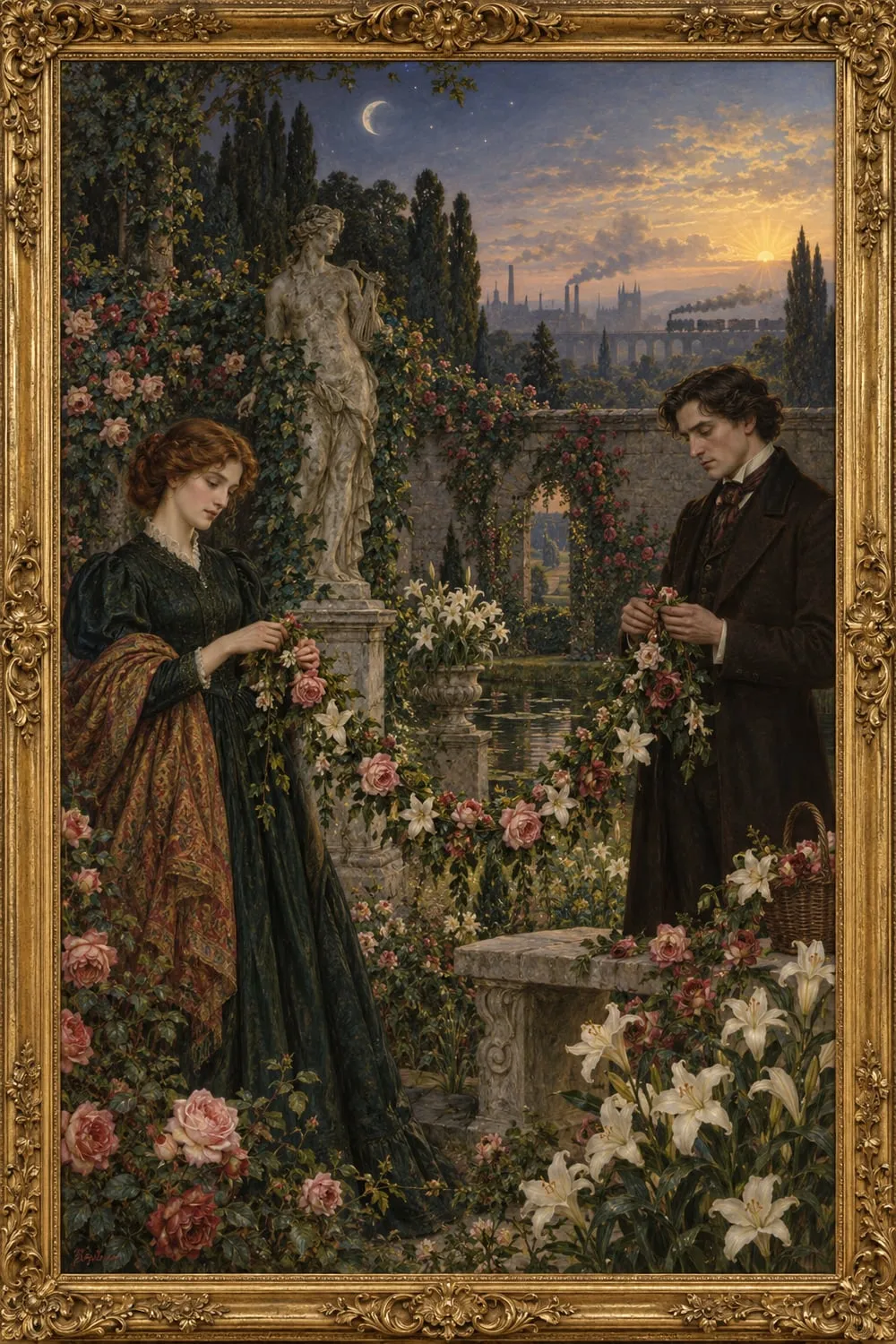
A June night against the modern age
The Garden of Eros
"Spirit of Beauty, tarry yet awhile!"
Poem
It is full summer now, the heart of June;Not yet the sunburnt reapers are astirUpon the upland meadow where too soonRich autumn time, the season’s usurer,Will lend his hoarded gold to all the trees,And see his treasure scattered by the wild and spendthrift breeze.
Too soon indeed! yet here the daffodil,That love-child of the Spring, has lingered onTo vex the rose with jealousy, and stillThe harebell spreads her azure pavilion,And like a strayed and wandering revellerAbandoned of its brothers, whom long since June’s messenger
The missel-thrush has frighted from the glade,One pale narcissus loiters fearfullyClose to a shadowy nook, where half afraidOf their own loveliness some violets lieThat will not look the gold sun in the faceFor fear of too much splendour—ah! methinks it is a place
Which should be trodden by PersephoneWhen wearied of the flowerless fields of Dis!Or danced on by the lads of Arcady!The hidden secret of eternal blissKnown to the Grecian here a man might find,Ah! you and I may find it now if Love and Sleep be kind.
There are the flowers which mourning HeraklesStrewed on the tomb of Hylas, columbine,Its white doves all a-flutter where the breezeKissed them too harshly, the small celandine,That yellow-kirtled chorister of eve,And lilac lady’s-smock—but let them bloom alone, and leave
Yon spirèd hollyhock red-crocketedTo sway its silent chimes, else must the bee,Its little bellringer, go seek insteadSome other pleasaunce; the anemoneThat weeps at daybreak, like a silly girlBefore her love, and hardly lets the butterflies unfurl
Their painted wings beside it—bid it pineIn pale virginity; the winter snowWill suit it better than those lips of thineWhose fires would but scorch it, rather goAnd pluck that amorous flower which blooms alone,Fed by the pander wind with dust of kisses not its own.
The trumpet-mouths of red convolvulusSo dear to maidens, creamy meadow-sweetWhiter than Juno’s throat and odorousAs all Arabia, hyacinths the feetOf Huntress Dian would be loth to marFor any dappled fawn—pluck these, and those fond flowers which are
Fairer than what Queen Venus trod uponBeneath the pines of Ida, eucharis,That morning star which does not dread the sun,And budding marjoram which but to kissWould sweeten Cytheraea’s lips and makeAdonis jealous—these for thy head—and for thy girdle take
Yon curving spray of purple clematisWhose gorgeous dye outflames the Tyrian King,And foxgloves with their nodding chalices,But that one narciss which the startled SpringLet from her kirtle fall when first she heardIn her own woods the wild tempestuous song of summer’s bird,
Ah! leave it for a subtle memoryOf those sweet tremulous days of rain and sun,When April laughed between her tears to seeThe early primrose with shy footsteps runFrom the gnarled oak-tree roots till all the wold,Spite of its brown and trampled leaves, grew bright with shimmering gold.
Nay, pluck it too, it is not half so sweetAs thou thyself, my soul’s idolatry!And when thou art a-wearied at thy feetShall oxlips weave their brightest tapestry,For thee the woodbine shall forget its prideAnd veil its tangled whorls, and thou shalt walk on daisies pied.
And I will cut a reed by yonder springAnd make the wood-gods jealous, and old PanWonder what young intruder dares to singIn these still haunts, where never foot of manShould tread at evening, lest he chance to spyThe marble limbs of Artemis and all her company.
And I will tell thee why the jacinth wearsSuch dread embroidery of dolorous moan,And why the hapless nightingale forbearsTo sing her song at noon, but weeps aloneWhen the fleet swallow sleeps, and rich men feast,And why the laurel trembles when she sees the lightening east.
And I will sing how sad ProserpinaUnto a grave and gloomy Lord was wed,And lure the silver-breasted HelenaBack from the lotus meadows of the dead,So shalt thou see that awful lovelinessFor which two mighty Hosts met fearfully in war’s abyss!
And then I’ll pipe to thee that Grecian taleHow Cynthia loves the lad Endymion,And hidden in a grey and misty veilHies to the cliffs of Latmos once the SunLeaps from his ocean bed in fruitless chaseOf those pale flying feet which fade away in his embrace.
And if my flute can breathe sweet melody,We may behold Her face who long agoDwelt among men by the Aegean sea,And whose sad house with pillaged porticoAnd friezeless wall and columns toppled downLooms o’er the ruins of that fair and violet-cinctured town.
Spirit of Beauty! tarry still awhile,They are not dead, thine ancient votaries,Some few there are to whom thy radiant smileIs better than a thousand victories,Though all the nobly slain of WaterlooRise up in wrath against them! tarry still, there are a few
Who for thy sake would give their manlihoodAnd consecrate their being; I at leastHave done so, made thy lips my daily food,And in thy temples found a goodlier feastThan this starved age can give me, spite of allIts new-found creeds so sceptical and so dogmatical.
Here not Cephissos, not Ilissos flows,The woods of white Colonos are not here,On our bleak hills the olive never blows,No simple priest conducts his lowing steerUp the steep marble way, nor through the townDo laughing maidens bear to thee the crocus-flowered gown.
Yet tarry! for the boy who loved thee best,Whose very name should be a memoryTo make thee linger, sleeps in silent restBeneath the Roman walls, and melodyStill mourns her sweetest lyre; none can playThe lute of Adonais: with his lips Song passed away.
Nay, when Keats died the Muses still had leftOne silver voice to sing his threnody,But ah! too soon of it we were bereftWhen on that riven night and stormy seaPanthea claimed her singer as her own,And slew the mouth that praised her; since which time we walk alone,
Save for that fiery heart, that morning starOf re-arisen England, whose clear eyeSaw from our tottering throne and waste of warThe grand Greek limbs of young DemocracyRise mightily like Hesperus and bringThe great Republic! him at least thy love hath taught to sing,
And he hath been with thee at Thessaly,And seen white Atalanta fleet of footIn passionless and fierce virginityHunting the tuskèd boar, his honied luteHath pierced the cavern of the hollow hill,And Venus laughs to know one knee will bow before her still.
And he hath kissed the lips of Proserpine,And sung the Galilaean’s requiem,That wounded forehead dashed with blood and wineHe hath discrowned, the Ancient Gods in himHave found their last, most ardent worshipper,And the new Sign grows grey and dim before its conqueror.
Spirit of Beauty! tarry with us still,It is not quenched the torch of poesy,The star that shook above the Eastern hillHolds unassailed its argent armouryFrom all the gathering gloom and fretful fight—O tarry with us still! for through the long and common night,
Morris, our sweet and simple Chaucer’s child,Dear heritor of Spenser’s tuneful reed,With soft and sylvan pipe has oft beguiledThe weary soul of man in troublous need,And from the far and flowerless fields of iceHas brought fair flowers to make an earthly paradise.
We know them all, Gudrun the strong men’s bride,Aslaug and Olafson we know them all,How giant Grettir fought and Sigurd died,And what enchantment held the king in thrallWhen lonely Brynhild wrestled with the powersThat war against all passion, ah! how oft through summer hours,
Long listless summer hours when the noonBeing enamoured of a damask roseForgets to journey westward, till the moonThe pale usurper of its tribute growsFrom a thin sickle to a silver shieldAnd chides its loitering car—how oft, in some cool grassy field
Far from the cricket-ground and noisy eight,At Bagley, where the rustling bluebells comeAlmost before the blackbird finds a mateAnd overstay the swallow, and the humOf many murmuring bees flits through the leaves,Have I lain poring on the dreamy tales his fancy weaves,
And through their unreal woes and mimic painWept for myself, and so was purified,And in their simple mirth grew glad again;For as I sailed upon that pictured tideThe strength and splendour of the storm was mineWithout the storm’s red ruin, for the singer is divine,
The little laugh of water falling downIs not so musical, the clammy goldClose hoarded in the tiny waxen townHas less of sweetness in it, and the oldHalf-withered reeds that waved in ArcadyTouched by his lips break forth again to fresher harmony.
Spirit of Beauty, tarry yet awhile!Although the cheating merchants of the martWith iron roads profane our lovely isle,And break on whirling wheels the limbs of Art,Ay! though the crowded factories begetThe blindworm Ignorance that slays the soul, O tarry yet!
For One at least there is—He bears his nameFrom Dante and the seraph Gabriel—Whose double laurels burn with deathless flameTo light thine altar; He too loves thee well,Who saw old Merlin lured in Vivien’s snare,And the white feet of angels coming down the golden stair,
Loves thee so well, that all the World for himA gorgeous-coloured vestiture must wear,And Sorrow take a purple diadem,Or else be no more Sorrow, and DespairGild its own thorns, and Pain, like Adon, beEven in anguish beautiful;—such is the empery
Which Painters hold, and such the heritageThis gentle solemn Spirit doth possess,Being a better mirror of his ageIn all his pity, love, and weariness,Than those who can but copy common things,And leave the Soul unpainted with its mighty questionings.
But they are few, and all romance has flown,And men can prophesy about the sun,And lecture on his arrows—how, alone,Through a waste void the soulless atoms run,How from each tree its weeping nymph has fled,And that no more ’mid English reeds a Naïad shows her head.
Methinks these new Actaeons boast too soonThat they have spied on beauty; what if weHave analysed the rainbow, robbed the moonOf her most ancient, chastest mystery,Shall I, the last Endymion, lose all hopeBecause rude eyes peer at my mistress through a telescope!
What profit if this scientific ageBurst through our gates with all its retinueOf modern miracles! Can it assuageOne lover’s breaking heart? what can it doTo make one life more beautiful, one dayMore godlike in its period? but now the Age of Clay
Returns in horrid cycle, and the earthHath borne again a noisy progenyOf ignorant Titans, whose ungodly birthHurls them against the august hierarchyWhich sat upon Olympus; to the DustThey have appealed, and to that barren arbiter they must
Repair for judgment; let them, if they can,From Natural Warfare and insensate Chance,Create the new Ideal rule for man!Methinks that was not my inheritance;For I was nurtured otherwise, my soulPasses from higher heights of life to a more supreme goal.
Lo! while we spake the earth did turn awayHer visage from the God, and Hecate’s boatRose silver-laden, till the jealous dayBlew all its torches out: I did not noteThe waning hours, to young EndymionsTime’s palsied fingers count in vain his rosary of suns!
Mark how the yellow iris wearilyLeans back its throat, as though it would be kissedBy its false chamberer, the dragon-fly,Who, like a blue vein on a girl’s white wrist,Sleeps on that snowy primrose of the night,Which ’gins to flush with crimson shame, and die beneath the light.
Come let us go, against the pallid shieldOf the wan sky the almond blossoms gleam,The corncrake nested in the unmown fieldAnswers its mate, across the misty streamOn fitful wing the startled curlews fly,And in his sedgy bed the lark, for joy that Day is nigh,
Scatters the pearlèd dew from off the grass,In tremulous ecstasy to greet the sun,Who soon in gilded panoply will passForth from yon orange-curtained pavilionHung in the burning east: see, the red rimO’ertops the expectant hills! it is the God! for love of him
Already the shrill lark is out of sight,Flooding with waves of song this silent dell—Ah! there is something more in that bird’s flightThan could be tested in a crucible!—But the air freshens, let us go, why soonThe woodmen will be here; how we have lived this night of June!
In brief
SummaryA long poem in six-line stanzas, set in a garden on a June night that the speaker spends with a beloved until dawn. It begins by naming the flowers of the garden and gathering them into a garland, then promises songs of Greek myth. The central part calls on the 'Spirit of Beauty' to stay in England, naming the poets who still serve her: Keats, the singer lost at sea who mourned him, a living 'fiery heart', Morris, and a painter-poet named from Dante and Gabriel. It attacks factories, railways and a science that studies the moon by telescope, and ends as the sun rises and the pair leave the garden.
Key themes
"It is full summer now, the heart of June;"
Related works
Explore more of Wilde's writing The Ballad of Reading GaolWritten after his release from prison, a long ballad about the hanging of a fellow prisoner, a trooper who had killed his wife. Wilde's last work, and his most read poem.Read more
  The SphinxA student in his room questions the ancient sphinx that has watched from its corner for a thousand years, and is frightened by what she knows.Read more
 Summary
It is 'full summer now, the heart of June', before the reapers stir. In a shadowy nook of the garden a late daffodil, a narcissus and shy violets linger, and the speaker thinks it a place fit for Persephone or 'the lads of Arcady', where 'you and I' might find the Greek secret of bliss. Surveying the garden, from the flowers that mourning Herakles strewed on the tomb of Hylas to the hollyhock and the anemone, he chooses which his beloved should pluck: convolvulus, meadow-sweet, hyacinths, eucharis and marjoram for the head, clematis and foxgloves for the girdle, and at last the narcissus too, since none is 'half so sweet / As thou thyself, my soul's idolatry!'
The speaker promises to cut a reed and pipe songs that will make old Pan wonder: why the jacinth bears its 'dolorous' marks, why the nightingale weeps by night, how Proserpina was wed to 'a grave and gloomy Lord', how Helen might be lured back from the dead, how Cynthia loves Endymion. If the flute is sweet enough, they may see the face of the goddess whose ruined temple looms over a 'violet-cinctured town' by the Aegean.
Then the poem turns to the 'Spirit of Beauty', begging her to 'tarry' in an England that has no Greek rivers or rites. Her votaries are few but not dead. The speaker mourns Keats, who 'sleeps in silent rest / Beneath the Roman walls', and the 'silver voice' that sang his threnody before a stormy sea took it; praises the 'fiery heart' who saw 'The grand Greek limbs of young Democracy' rise; recalls lying in the grass at Bagley, 'Far from the cricket-ground and noisy eight', reading Morris's tales of Gudrun, Grettir, Sigurd and Brynhild; and honours the painter-poet who 'bears his name / From Dante and the seraph Gabriel', whose art makes even Sorrow beautiful.
Such servants are few, for 'all romance has flown'. Men lecture on the sun, 'analysed the rainbow' and peer at the moon 'through a telescope'; 'cheating merchants' build 'iron roads', and factories breed 'The blindworm Ignorance'. The speaker asks what a 'scientific age' can do for 'One lover's breaking heart', calls its thinkers 'ignorant Titans' who appeal to 'Natural Warfare and insensate Chance', and claims a higher inheritance for his own soul.
While they talk, the night has passed. The moon has risen and the day has blown out its torches; a yellow iris leans towards a sleeping dragon-fly, the corncrake answers its mate, curlews fly over the misty stream, and the lark rises as 'the red rim' of the sun tops the hills. 'There is something more in that bird's flight / Than could be tested in a crucible', the speaker says, and the two leave before the woodmen come: 'how we have lived this night of June!'
Characters
The speaker
The last Endymion
A young devotee of Beauty who spends a June night in a garden with his beloved, gathering flowers and promising songs of Greek myth. He counts himself among Beauty's few votaries, has read Morris in the grass at Bagley, and scorns a scientific age, calling himself 'the last Endymion'.
The beloved
Companion of the night
Addressed as 'thou' and 'my soul's idolatry', the speaker's companion is crowned with a garland of garden flowers and promised songs of gods and heroes. The beloved never speaks, but shares the whole night until dawn, when the speaker says 'let us go'.
The Spirit of Beauty
The goddess implored
The presence the speaker begs again and again to 'tarry' in England. Her 'ancient votaries' are few but not dead, and the speaker has 'made thy lips my daily food'. She is threatened by merchants, factories and a science that leaves 'the Soul unpainted'.
Keats
The poet mourned
Named as the boy 'who loved thee best', Keats 'sleeps in silent rest / Beneath the Roman walls'. With his death, the speaker says, 'Song passed away', and none can now play 'The lute of Adonais'.
The 'fiery heart'
Morning star of England
A living poet, 'that morning star / Of re-arisen England', who saw 'The grand Greek limbs of young Democracy' rise. He has seen Atalanta hunting, kissed the lips of Proserpine and sung 'the Galilaean's requiem', and in him the Ancient Gods have found 'their last, most ardent worshipper'.
Morris
Chaucer's child
The poet the speaker calls 'our sweet and simple Chaucer's child' and heir to 'Spenser's tuneful reed'. From 'the far and flowerless fields of ice' he has brought tales of Gudrun, Grettir, Sigurd and Brynhild, over which the speaker has wept and laughed in the grass at Bagley.
The painter-poet
Beauty's painter
The artist who 'bears his name / From Dante and the seraph Gabriel' and whose 'double laurels' light Beauty's altar. He 'saw old Merlin lured in Vivien's snare' and angels on 'the golden stair', and makes even Sorrow wear 'a purple diadem'.
Themes
Beauty against the modern age
The refrain 'Spirit of Beauty! tarry' is a plea against a hostile present. 'Cheating merchants' build 'iron roads', 'crowded factories beget / The blindworm Ignorance', and science reduces the moon to something seen 'through a telescope'. The speaker asks what such an age can do 'To make one life more beautiful', and answers with the lark, whose flight holds more 'Than could be tested in a crucible'.
Poets as servants of Beauty
The central stanzas are a roll of honour: Keats, with whose death 'Song passed away'; the singer lost at sea; the 'fiery heart' who saw 'young Democracy' rise; Morris, 'our sweet and simple Chaucer's child'; and the painter-poet who makes Sorrow 'take a purple diadem'. The speaker counts himself among Beauty's few votaries, having 'made thy lips my daily food'.
The Greek ideal
Greek myth fills the garden. The flowers recall Persephone, Herakles and Hylas, and Venus 'Beneath the pines of Ida', and the promised songs are of Proserpina, Helen and Endymion. England lacks the Greek landscape, 'Here not Cephissos, not Ilissos flows', yet the speaker calls himself 'the last Endymion', faithful to the moon whatever the telescope shows.
Love and the passing night
The poem is framed by a single June night shared with a beloved. It opens with flowers gathered 'for thy head' and 'for thy girdle', and ends at dawn as the speaker urges 'let us go' before the woodmen arrive. The closing cry, 'how we have lived this night of June!', sets the fullness of one night against an age the speaker calls 'starved'.
Context
The poem is written in six-line stanzas whose last line is longer than the rest, and many stanzas run on into the next without a pause. It names Keats and Morris, and identifies other poets by description, including one who 'bears his name / From Dante and the seraph Gabriel'. Its images of 'Rich autumn time, the season's usurer', who lends 'his hoarded gold to all the trees', recur almost word for word in the last part of 'Ravenna'.
About this edition
- Text: the complete work from Standard Ebooks, released into the public domain (CC0 1.0). We change only the layout.
- Download the EPUB of the whole book it comes from, free, for any e-reader.
- Every quotation and glossary word in these notes is checked against the text.