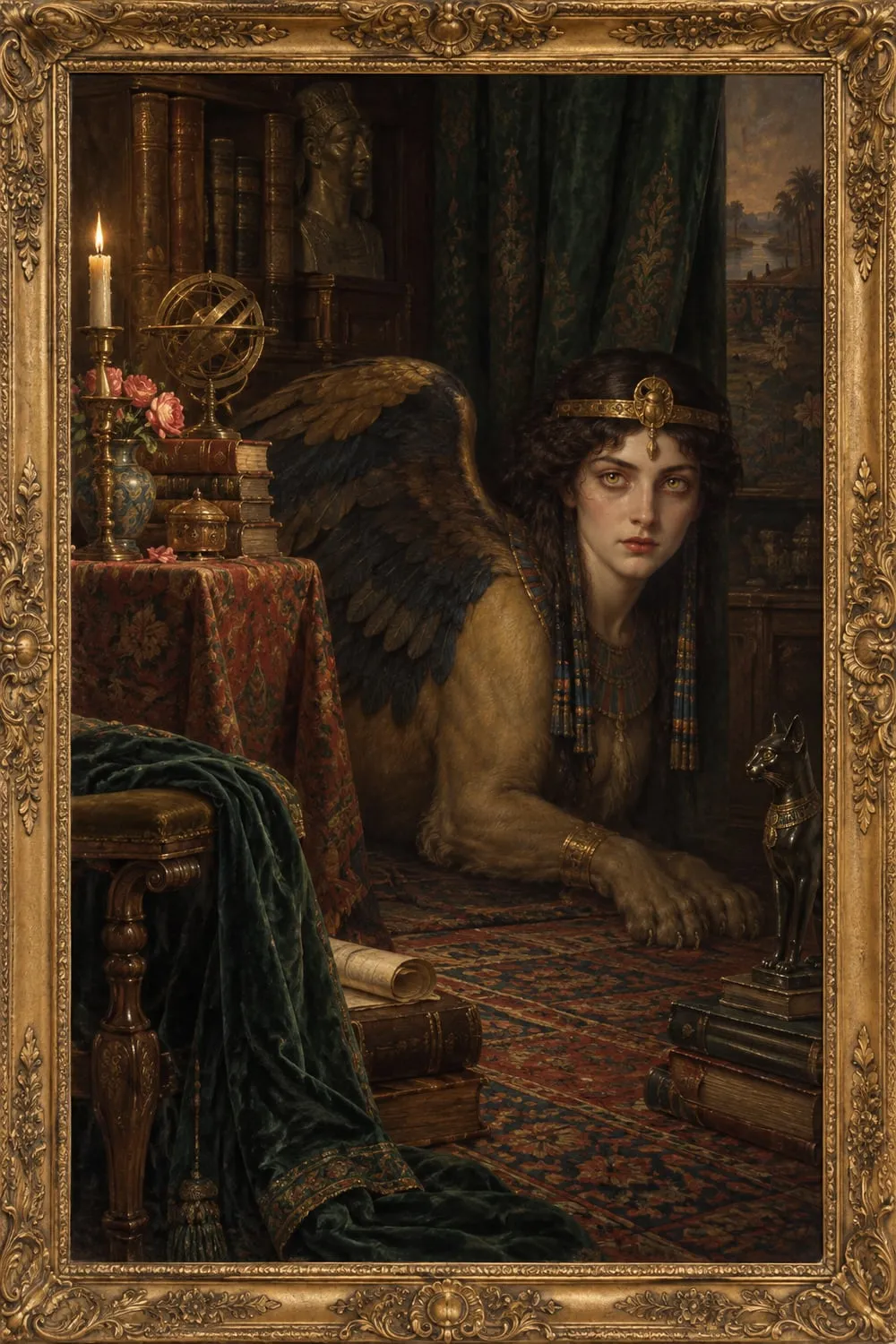
A student, a Sphinx and centuries of desire
The Sphinx
"Come forth you exquisite grotesque! half woman and half animal!"
Poem
Listen · 17 min
Read by Algy Pug for LibriVox. Public domain.
To Marcel Schwob in Friendship and in Admiration
In a dim corner of my room for longer than my fancy thinksA beautiful and silent Sphinx has watched me through the shifting gloom.
Inviolate and immobile she does not rise she does not stirFor silver moons are naught to her and naught to her the suns that reel.
Red follows grey across the air, the waves of moonlight ebb and flowBut with the Dawn she does not go and in the night-time she is there.
Dawn follows Dawn and Nights grow old and all the while this curious catLies couching on the Chinese mat with eyes of satin rimmed with gold.
Upon the mat she lies and leers and on the tawny throat of herFlutters the soft and silky fur or ripples to her pointed ears.
Come forth, my lovely seneschal! so somnolent, so statuesque!Come forth you exquisite grotesque! half woman and half animal!
Come forth my lovely languorous Sphinx! and put your head upon my knee!And let me stroke your throat and see your body spotted like the Lynx!
And let me touch those curving claws of yellow ivory and graspThe tail that like a monstrous Asp coils round your heavy velvet paws!
A thousand weary centuries are thine while I have hardly seenSome twenty summers cast their green for Autumn’s gaudy liveries.
But you can read the Hieroglyphs on the great sandstone obelisks,And you have talked with Basilisks, and you have looked on Hippogriffs.
O tell me, were you standing by when Isis to Osiris knelt?And did you watch the Egyptian melt her union for Antony
And drink the jewel-drunken wine and bend her head in mimic aweTo see the huge proconsul draw the salted tunny from the brine?
And did you mark the Cyprian kiss white Adon on his catafalque?And did you follow Amenalk, the God of Heliopolis?
And did you talk with Thoth, and did you hear the moon-horned Io weep?And know the painted kings who sleep beneath the wedge-shaped Pyramid?
Lift up your large black satin eyes which are like cushions where one sinks!Fawn at my feet, fantastic Sphinx! and sing me all your memories!
Sing to me of the Jewish maid who wandered with the Holy Child,And how you led them through the wild, and how they slept beneath your shade.
Sing to me of that odorous green eve when crouching by the margeYou heard from Adrian’s gilded barge the laughter of Antinous
And lapped the stream and fed your drouth and watched with hot and hungry stareThe ivory body of that rare young slave with his pomegranate mouth!
Sing to me of the Labyrinth in which the twi-formed bull was stalled!Sing to me of the night you crawled across the temple’s granite plinth
When through the purple corridors the screaming scarlet Ibis flewIn terror, and a horrid dew dripped from the moaning Mandragores,
And the great torpid crocodile within the tank shed slimy tears,And tare the jewels from his ears and staggered back into the Nile,
And the priests cursed you with shrill psalms as in your claws you seized their snakeAnd crept away with it to slake your passion by the shuddering palms.
Who were your lovers? who were they who wrestled for you in the dust?Which was the vessel of your Lust? What Leman had you, every day?
Did giant Lizards come and crouch before you on the reedy banks?Did Gryphons with great metal flanks leap on you in your trampled couch?
Did monstrous hippopotami come sidling toward you in the mist?Did gilt-scaled dragons writhe and twist with passion as you passed them by?
And from the brick-built Lycian tomb what horrible Chimera cameWith fearful heads and fearful flame to breed new wonders from your womb?
Or had you shameful secret quests and did you harry to your homeSome Nereid coiled in amber foam with curious rock crystal breasts?
Or did you treading through the froth call to the brown SidonianFor tidings of Leviathan, Leviathan or Behemoth?
Or did you when the sun was set climb up the cactus-covered slopeTo meet your swarthy Ethiop whose body was of polished jet?
Or did you while the earthen skiffs dropped down the grey Nilotic flatsAt twilight and the flickering bats flew round the temple’s triple glyphs
Steal to the border of the bar and swim across the silent lakeAnd slink into the vault and make the Pyramid your lúpanar
Till from each black sarcophagus rose up the painted swathèd dead?Or did you lure unto your bed the ivory-horned Tragelaphos?
Or did you love the god of flies who plagued the Hebrews and was splashedWith wine unto the waist? or Pasht, who had green beryls for her eyes?
Or that young god, the Tyrian, who was more amorous than the doveOf Ashtaroth? or did you love the god of the Assyrian
Whose wings, like strange transparent talc, rose high above his hawk-faced head,Painted with silver and with red and ribbed with rods of Oreichalch?
Or did huge Apis from his car leap down and lay before your feetBig blossoms of the honey-sweet and honey-coloured nenuphar?
How subtle-secret is your smile! Did you love none then? Nay, I knowGreat Ammon was your bedfellow! He lay with you beside the Nile!
The river-horses in the slime trumpeted when they saw him comeOdorous with Syrian galbanum and smeared with spikenard and with thyme.
He came along the river bank like some tall galley argent-sailed,He strode across the waters, mailed in beauty, and the waters sank.
He strode across the desert sand: he reached the valley where you lay:He waited till the dawn of day: then touched your black breasts with his hand.
You kissed his mouth with mouths of flame: you made the hornèd god your own:You stood behind him on his throne: you called him by his secret name.
You whispered monstrous oracles into the caverns of his ears:With blood of goats and blood of steers you taught him monstrous miracles.
White Ammon was your bedfellow! Your chamber was the steaming Nile!And with your curved archaic smile you watched his passion come and go.
With Syrian oils his brows were bright: and wide-spread as a tent at noonHis marble limbs made pale the moon and lent the day a larger light.
His long hair was nine cubits’ span and coloured like that yellow gemWhich hidden in their garment’s hem the merchants bring from Kurdistan.
His face was as the must that lies upon a vat of new-made wine:The seas could not insapphirine the perfect azure of his eyes.
His thick soft throat was white as milk and threaded with thin veins of blue:And curious pearls like frozen dew were broidered on his flowing silk.
On pearl and porphyry pedestalled he was too bright to look upon:For on his ivory breast there shone the wondrous ocean-emerald,
That mystic moonlit jewel which some diver of the Colchian cavesHad found beneath the blackening waves and carried to the Colchian witch.
Before his gilded galiot ran naked vine-wreathed corybants,And lines of swaying elephants knelt down to draw his chariot,
And lines of swarthy Nubians bare up his litter as he rodeDown the great granite-paven road between the nodding peacock-fans.
The merchants brought him steatite from Sidon in their painted ships:The meanest cup that touched his lips was fashioned from a chrysolite.
The merchants brought him cedar chests of rich apparel bound with cords:His train was borne by Memphian lords: young kings were glad to be his guests.
Ten hundred shaven priests did bow to Ammon’s altar day and night,Ten hundred lamps did wave their light through Ammon’s carven house—and now
Foul snake and speckled adder with their young ones crawl from stone to stoneFor ruined is the house and prone the great rose-marble monolith!
Wild ass or trotting jackal comes and couches in the mouldering gates:Wild satyrs call unto their mates across the fallen fluted drums.
And on the summit of the pile the blue-faced ape of Horus sitsAnd gibbers while the fig-tree splits the pillars of the peristyle.
The god is scattered here and there: deep hidden in the windy sandI saw his giant granite hand still clenched in impotent despair.
And many a wandering caravan of stately Negroes silken-shawled,Crossing the desert, halts appalled before the neck that none can span.
And many a bearded Bedouin draws back his yellow-striped burnousTo gaze upon the Titan thews of him who was thy paladin.
Go, seek his fragments on the moor and wash them in the evening dew,And from their pieces make anew thy mutilated paramour!
Go, seek them where they lie alone and from their broken pieces makeThy bruisèd bedfellow! And wake mad passions in the senseless stone!
Charm his dull ear with Syrian hymns! he loved your body! oh, be kind,Pour spikenard on his hair, and wind soft rolls of linen round his limbs!
Wind round his head the figured coins! stain with red fruits those pallid lips!Weave purple for his shrunken hips! and purple for his barren loins!
Away to Egypt! Have no fear. Only one God has ever died.Only one God has let His side be wounded by a soldier’s spear.
But these, thy lovers, are not dead. Still by the hundred-cubit gateDog-faced Anubis sits in state with lotus-lilies for thy head.
Still from his chair of porphyry gaunt Memnon strains his lidless eyesAcross the empty land, and cries each yellow morning unto thee.
And Nilus with his broken horn lies in his black and oozy bedAnd till thy coming will not spread his waters on the withering corn.
Your lovers are not dead, I know. They will rise up and hear your voiceAnd clash their cymbals and rejoice and run to kiss your mouth! And so,
Set wings upon your argosies! Set horses to your ebon car!Back to your Nile! Or if you are grown sick of dead divinities
Follow some roving lion’s spoor across the copper-coloured plain,Reach out and hale him by the mane and bid him be your paramour!
Couch by his side upon the grass and set your white teeth in his throatAnd when you hear his dying note lash your long flanks of polished brass
And take a tiger for your mate, whose amber sides are flecked with black,And ride upon his gilded back in triumph through the Theban gate,
And toy with him in amorous jests, and when he turns, and snarls, and gnaws,O smite him with your jasper claws! and bruise him with your agate breasts!
Why are you tarrying? Get hence! I weary of your sullen ways,I weary of your steadfast gaze, your somnolent magnificence.
Your horrible and heavy breath makes the light flicker in the lamp,And on my brow I feel the damp and dreadful dews of night and death.
Your eyes are like fantastic moons that shiver in some stagnant lake,Your tongue is like a scarlet snake that dances to fantastic tunes,
Your pulse makes poisonous melodies, and your black throat is like the holeLeft by some torch or burning coal on Saracenic tapestries.
Away! The sulphur-coloured stars are hurrying through the Western gate!Away! Or it may be too late to climb their silent silver cars!
See, the dawn shivers round the grey gilt-dialled towers, and the rainStreams down each diamonded pane and blurs with tears the wannish day.
What snake-tressed fury fresh from Hell, with uncouth gestures and unclean,Stole from the poppy-drowsy queen and led you to a student’s cell?
What songless tongueless ghost of sin crept through the curtains of the night,And saw my taper burning bright, and knocked, and bade you enter in?
Are there not others more accursed, whiter with leprosies than I?Are Abana and Pharphar dry that you come here to slake your thirst?
Get hence, you loathsome mystery! Hideous animal, get hence!You wake in me each bestial sense, you make me what I would not be.
You make my creed a barren sham, you wake foul dreams of sensual life,And Atys with his blood-stained knife were better than the thing I am.
False Sphinx! False Sphinx! By reedy Styx old Charon, leaning on his oar,Waits for my coin. Go thou before, and leave me to my crucifix,
Whose pallid burden, sick with pain, watches the world with wearied eyes,And weeps for every soul that dies, and weeps for every soul in vain.
In brief
SummaryIn a dim corner of a student's room lies a Sphinx, beautiful, silent and unmoving, who has watched him for longer than he can remember. The speaker, who has seen barely twenty summers, calls her to lay her head on his knee and sing him the memories of her thousand centuries. He asks what she saw in the ancient world: Isis kneeling to Osiris, the Egyptian queen dissolving a pearl for Antony, the Jewish maid and the Holy Child in the wilderness, Antinous laughing on Adrian's barge. His questions grow wilder as he imagines her lovers, from gryphons and hippopotami to strange gods, until he decides that her true bedfellow was the god Ammon.
He describes Ammon in splendour, with his jewels, priests and elephants, and then in ruin: his temple fallen, his giant granite hand clenched in the sand. He urges the Sphinx to go and rebuild her 'mutilated paramour', to return to the Nile where her old gods still wait, or to take a lion or a tiger as her mate. Then his mood turns. Sickened by her heavy breath and steady gaze, and by the 'bestial sense' she wakes in him, he orders her out as a grey dawn breaks. The poem ends with him turning from the 'False Sphinx' to his crucifix, whose suffering figure weeps for every soul in vain.
Key themes
"A beautiful and silent Sphinx has watched me through the shifting gloom."
Related works
Explore more of Wilde's writing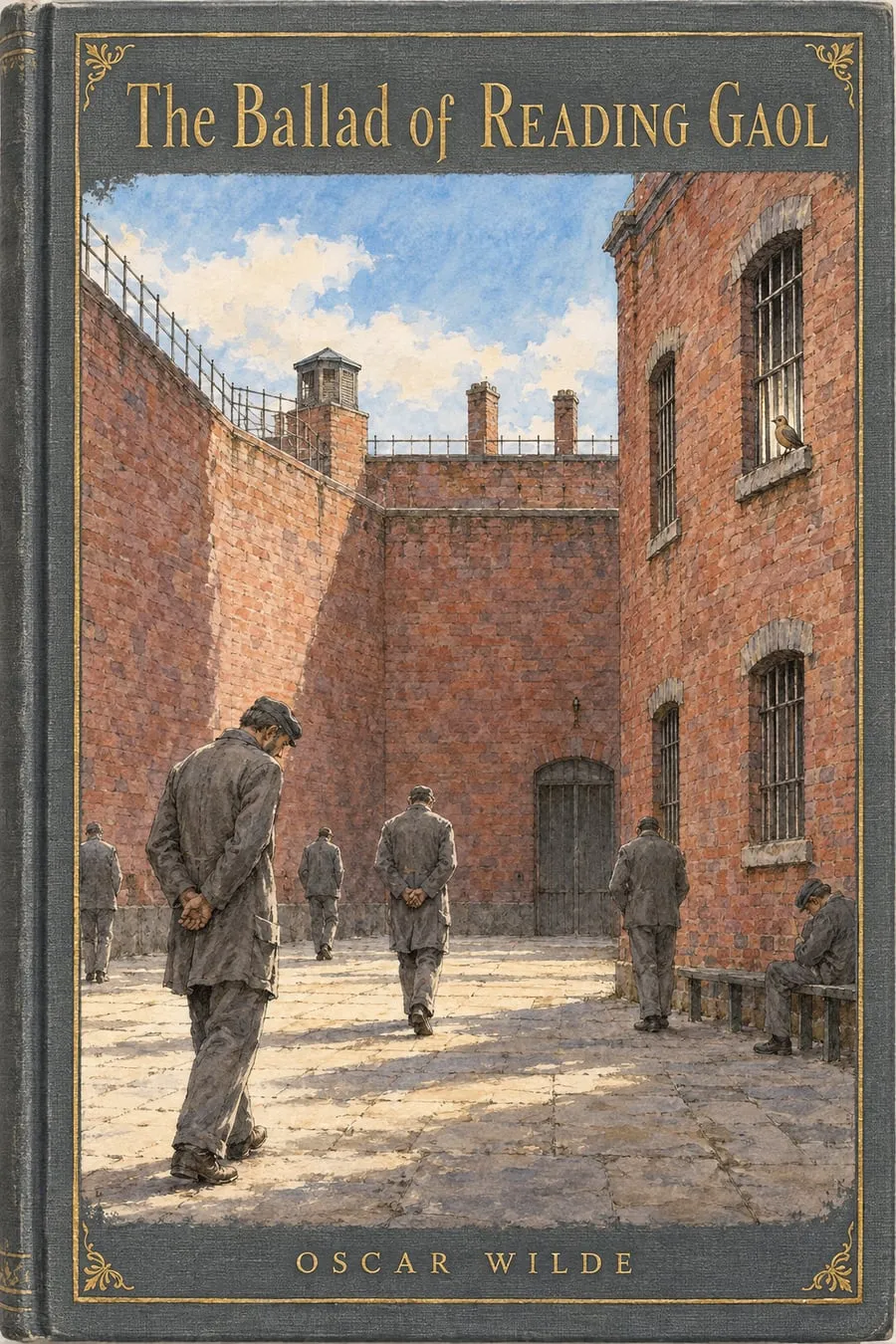 The Ballad of Reading GaolWritten after his release from prison, a long ballad about the hanging of a fellow prisoner, a trooper who had killed his wife. Wilde's last work, and his most read poem.Read more
 Summary
The poem opens with the Sphinx lying in a dim corner of the speaker's room, 'Inviolate and immobile' while moons and suns pass, a 'curious cat' couched on a Chinese mat with satin eyes rimmed with gold. He calls her forth as his 'lovely seneschal', 'half woman and half animal', and longs to stroke her spotted body and touch her ivory claws. Setting her thousand weary centuries against his twenty summers, he asks what she has witnessed: Isis kneeling to Osiris, the Egyptian queen melting her pearl for Antony, the Cyprian goddess kissing dead Adon, the moon-horned Io weeping, the painted kings asleep in the Pyramid.
He begs her to sing of her memories: how she led the Jewish maid and the Holy Child through the wilderness, how she watched Antinous on Adrian's gilded barge, the Labyrinth where the bull was stalled, and the night she seized the priests' snake and crept away with it. Then he asks who her lovers were, and imagines a monstrous procession: giant lizards, gryphons, hippopotami, dragons, the Chimera, a Nereid, an Ethiop, the god of flies, Pasht with her beryl eyes, Apis with his water lilies. At last he declares that 'Great Ammon was your bedfellow!', and describes the god's beauty and state: his hair nine cubits long, his jewels, his elephants, his thousand priests and lamps.
Then the splendour collapses. Ammon's house is ruined: snakes crawl through it, jackals couch in its gates, the ape of Horus gibbers on the rubble, and the god's giant hand lies clenched in the sand. The speaker urges the Sphinx to seek his fragments and make anew her 'mutilated paramour'. Only one God has ever died, he says; her lovers are not dead, for Anubis, Memnon and the Nile still wait for her. She should go back to Egypt, or, if she is tired of dead gods, take a lion or a tiger as her mate.
Suddenly the speaker cannot bear her. 'Why are you tarrying? Get hence!' he cries. Her breath makes the lamp flicker, her eyes are like moons in a stagnant lake, her tongue is a scarlet snake. As a grey, rainy dawn breaks, he asks what fury led her to 'a student's cell', and accuses her of waking foul dreams and making his creed 'a barren sham'. Calling her 'False Sphinx', he says that Charon waits for his coin, and sends her away, leaving him to his crucifix, whose pale figure 'weeps for every soul in vain'.
Characters

The speaker
The student in his cell
A young scholar, barely twenty, who reads by a burning taper in what he calls 'a student's cell'. Steeped in ancient legend, he begs the Sphinx for her memories and imagines her lovers in ever wilder detail. As the night ends he recoils from the desires she has woken, calls her false and loathsome, and turns to his crucifix, though with little confidence that it can save him.
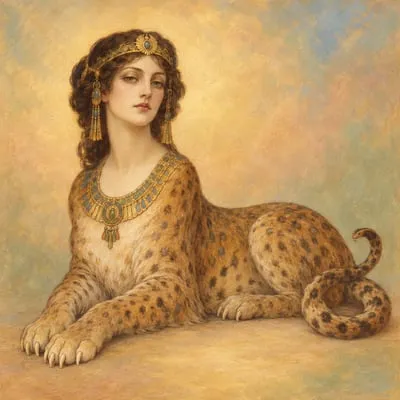
The Sphinx
Half woman, half animal
A beautiful, silent creature who lies in the corner of the speaker's room like a great cat, with satin eyes rimmed with gold, a body spotted like a lynx, ivory claws and a tail that coils like an asp. She is thousands of years old and has seen the gods and heroes of the ancient world. She never speaks or moves in the poem; everything said of her comes from the speaker's fascinated and fearful imagination.
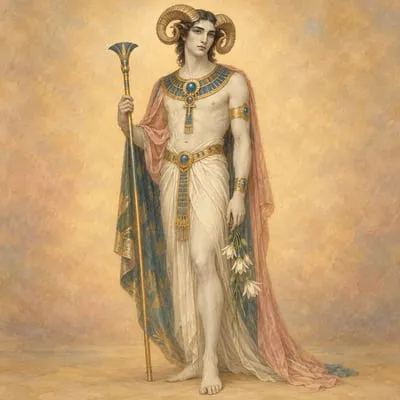
Ammon
The Sphinx's divine lover
The horned god whom the speaker names as the Sphinx's bedfellow, who came along the Nile 'like some tall galley argent-sailed'. The poem describes his marble limbs, azure eyes, jewels, elephants and priests in lavish detail. Now his temple is a ruin and his broken statue lies scattered in the desert, so the speaker mockingly bids the Sphinx rebuild her 'mutilated paramour'.
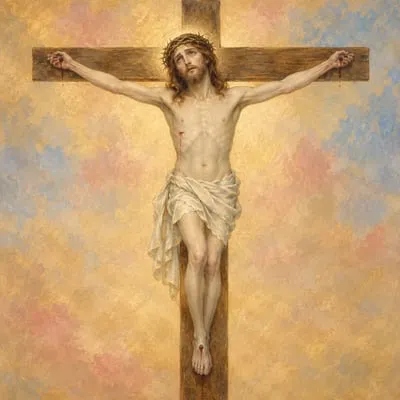
The figure on the crucifix
The suffering refuge
The Christ of the speaker's crucifix, 'Whose pallid burden, sick with pain, watches the world with wearied eyes'. He is the 'one God' who has ever died, set against the undying pagan gods of the Sphinx. In the last lines the speaker turns to him for refuge, but the figure only 'weeps for every soul that dies, and weeps for every soul in vain'.
Themes
Temptation and revulsion
The poem moves from invitation to expulsion. At first the speaker asks the Sphinx to 'put your head upon my knee' and longs to stroke her; by the end he cries 'Get hence, you loathsome mystery!' The turn comes from what she awakens in him: 'You wake in me each bestial sense, you make me what I would not be.' She is desire itself, fascinating while it is pictured in far-off lands and centuries, horrible once it is felt in his own room. His final retreat to the crucifix is less a triumph than a flight.
The weight of the past
The Sphinx has a thousand weary centuries, while the speaker has 'hardly seen / Some twenty summers', and his torrent of questions tries to seize all that time at once. Egyptian, Greek, Hebrew and Roman stories crowd together: Isis and Osiris, Antony, Adon, the Holy Child, Antinous, the Labyrinth, Leviathan and Behemoth. The Sphinx never answers, so the past she holds is really the speaker's own feverish reading, poured out before a silent listener. History here is a store of sensations more than a record of events.
Pagan gods and Christian faith
The poem sets the old gods against Christ. Ammon lies shattered in the sand, but the speaker insists that 'Only one God has ever died', and that the Sphinx's lovers, Anubis, Memnon and the Nile, still wait for her. At the close he turns to the crucifix, 'Whose pallid burden, sick with pain, watches the world with wearied eyes'. Yet the last word is doubtful, for the Christ he turns to 'weeps for every soul in vain'. Faith is a refuge the speaker needs, not a victory he is sure of.
Sound and ornament
The poem is as much a display of language as a story. Each pair of long lines hides rhymes inside it, as 'thinks' and 'Sphinx' chime in the opening, and the verse piles up rare words such as 'nenuphar', 'galiot' and 'Oreichalch', with even a coinage in 'The seas could not insapphirine the perfect azure of his eyes'. Jewels and precious materials fill the portrait of Ammon, from a chrysolite cup to the 'wondrous ocean-emerald'. The richness is part of the meaning: the decorated surface is the lure the speaker finally rejects.
The monstrous and the erotic
The Sphinx is 'half woman and half animal', and the speaker imagines her desires in the same hybrid terms. His questions about her lovers conjure gryphons 'with great metal flanks', sidling hippopotami, a Chimera come 'to breed new wonders from your womb', and a god with a hawk face and wings of talc. Even his advice is violent: take a lion as your paramour and 'set your white teeth in his throat'. Desire in the poem is never tender; it is strange, animal and cruel, which is why its pull frightens him.
Quotes
"A beautiful and silent Sphinx has watched me through the shifting gloom."
The speaker
"Lift up your large black satin eyes which are like cushions where one sinks!"
The speaker
"Only one God has ever died."
The speaker
"You wake in me each bestial sense, you make me what I would not be."
The speaker
"And weeps for every soul that dies, and weeps for every soul in vain."
The speaker
Context
The Sphinx was published in 1894 by Elkin Mathews and John Lane, with decorations by Charles Ricketts. It carries the dedication 'To Marcel Schwob in Friendship and in Admiration', addressed to the French writer Marcel Schwob.
The poem is written in long lines arranged in pairs, and each pair hides a four-line stanza: rhymes fall in the middle and at the end of each line, so that 'room', 'thinks', 'Sphinx' and 'gloom' in the opening couplet rhyme in the pattern of Tennyson's In Memoriam, stretched into two lines. The effect is slow, heavy and incantatory, suited to a poem that moves by questions and lists.
Wilde had already used the Sphinx as an emblem of mystery in his story The Sphinx Without a Secret (1887). Here the image becomes darker and more sensual, and the poem's catalogue of Egyptian, Greek and Hebrew legend, full of rare and invented words, belongs to the decorative, exotic manner of the 1890s.
Published in 1894 with decorations by Charles Ricketts.
About this edition
- Text: the complete work from Standard Ebooks, released into the public domain (CC0 1.0). We change only the layout.
- Download the EPUB of the whole book it comes from, free, for any e-reader.
- Audiobook: read by Algy Pug for LibriVox, in the public domain.
- Every quotation and glossary word in these notes is checked against the text.