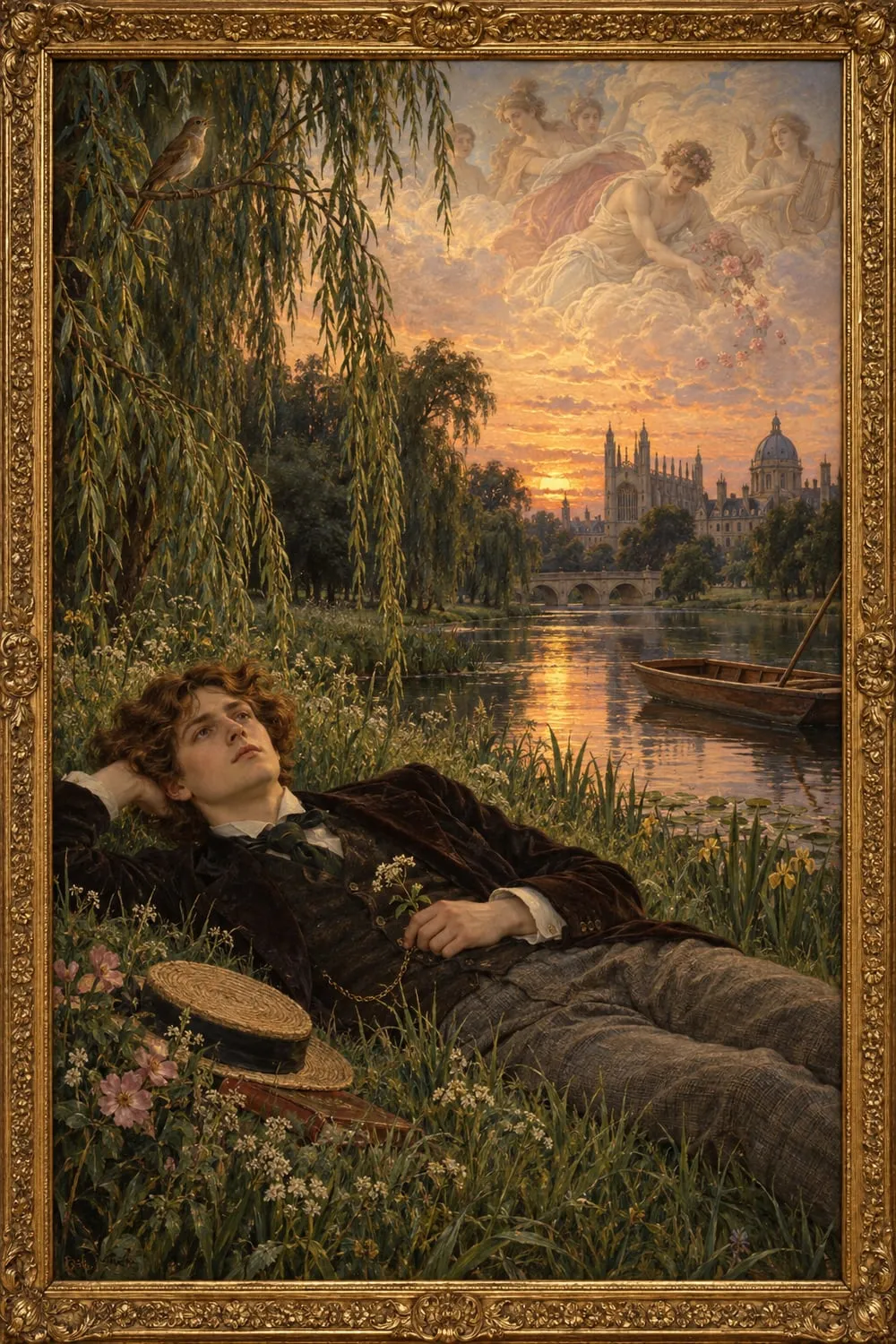
A nightingale by the Thames at dusk
The Burden of Itys
"This English Thames is holier far than Rome,"
Poem
This English Thames is holier far than Rome,Those harebells like a sudden flush of seaBreaking across the woodland, with the foamOf meadow-sweet and white anemoneTo fleck their blue waves—God is likelier thereThan hidden in that crystal-hearted star the pale monks bear!
Those violet-gleaming butterflies that takeYon creamy lily for their pavilionAre monsignores, and where the rushes shakeA lazy pike lies basking in the sun,His eyes half shut—he is some mitred oldBishop in partibus! look at those gaudy scales all green and gold.
The wind the restless prisoner of the treesDoes well for Palaestrina, one would sayThe mighty master’s hands were on the keysOf the Maria organ, which they playWhen early on some sapphire Easter mornIn a high litter red as blood or sin the Pope is borne
From his dark House out to the BalconyAbove the bronze gates and the crowded square,Whose very fountains seem for ecstasyTo toss their silver lances in the air,And stretching out weak hands to East and WestIn vain sends peace to peaceless lands, to restless nations rest.
Is not yon lingering orange after-glowThat stays to vex the moon more fair than allRome’s lordliest pageants! strange, a year agoI knelt before some crimson CardinalWho bare the Host across the Esquiline,And now—those common poppies in the wheat seem twice as fine.
The blue-green beanfields yonder, tremulousWith the last shower, sweeter perfume bringThrough this cool evening than the odorousFlame-jewelled censers the young deacons swing,When the grey priest unlocks the curtained shrine,And makes God’s body from the common fruit of corn and vine.
Poor Fra Giovanni bawling at the massWere out of tune now, for a small brown birdSings overhead, and through the long cool grassI see that throbbing throat which once I heardOn starlit hills of flower-starred Arcady,Once where the white and crescent sand of Salamis meets sea.
Sweet is the swallow twittering on the eavesAt daybreak, when the mower whets his scythe,And stock-doves murmur, and the milkmaid leavesHer little lonely bed, and carols blitheTo see the heavy-lowing cattle waitStretching their huge and dripping mouths across the farmyard gate.
And sweet the hops upon the Kentish leas,And sweet the wind that lifts the new-mown hay,And sweet the fretful swarms of grumbling beesThat round and round the linden blossoms play;And sweet the heifer breathing in the stall,And the green bursting figs that hang upon the red-brick wall,
And sweet to hear the cuckoo mock the springWhile the last violet loiters by the well,And sweet to hear the shepherd Daphnis singThe song of Linus through a sunny dellOf warm Arcadia where the corn is goldAnd the slight lithe-limbed reapers dance about the wattled fold.
And sweet with young Lycoris to reclineIn some Illyrian valley far away,Where canopied on herbs amaracineWe too might waste the summer-trancèd dayMatching our reeds in sportive rivalry,While far beneath us frets the troubled purple of the sea.
But sweeter far if silver-sandalled footOf some long-hidden God should ever treadThe Nuneham meadows, if with reeded flutePressed to his lips some Faun might raise his headBy the green water-flags, ah! sweet indeedTo see the heavenly herdsman call his white-fleeced flock to feed.
Then sing to me thou tuneful chorister,Though what thou sing’st be thine own requiem!Tell me thy tale thou hapless chroniclerOf thine own tragedies! do not contemnThese unfamiliar haunts, this English field,For many a lovely coronal our northern isle can yield
Which Grecian meadows know not, many a roseWhich all day long in vales AeolianA lad might seek in vain for over-growsOur hedges like a wanton courtesanUnthrifty of its beauty; lilies tooIlissos never mirrored star our streams, and cockles blue
Dot the green wheat which, though they are the signsFor swallows going south, would never spreadTheir azure tents between the Attic vines;Even that little weed of ragged red,Which bids the robin pipe, in ArcadyWould be a trespasser, and many an unsung elegy
Sleeps in the reeds that fringe our winding ThamesWhich to awake were sweeter ravishmentThan ever Syrinx wept for, diademsOf brown bee-studded orchids which were meantFor Cytheraea’s brows are hidden hereUnknown to Cytheraea, and by yonder pasturing steer
There is a tiny yellow daffodil,The butterfly can see it from afar,Although one summer evening’s dew could fillIts little cup twice over ere the starHad called the lazy shepherd to his foldAnd be no prodigal; each leaf is flecked with spotted gold
As if Jove’s gorgeous leman DanaeHot from his gilded arms had stooped to kissThe trembling petals, or young MercuryLow-flying to the dusky ford of DisHad with one feather of his pinionsJust brushed them! the slight stem which bears the burden of its suns
Is hardly thicker than the gossamer,Or poor Arachne’s silver tapestry—Men say it bloomed upon the sepulchreOf One I sometime worshipped, but to meIt seems to bring diviner memoriesOf faun-loved Heliconian glades and blue nymph-haunted seas,
Of an untrodden vale at Tempe whereOn the clear river’s marge Narcissus lies,The tangle of the forest in his hair,The silence of the woodland in his eyes,Wooing that drifting imagery which isNo sooner kissed than broken; memories of Salmacis
Who is not boy nor girl and yet is both,Fed by two fires and unsatisfiedThrough their excess, each passion being lothFor love’s own sake to leave the other’s sideYet killing love by staying; memoriesOf Oreads peeping through the leaves of silent moonlit trees,
Of lonely Ariadne on the wharfAt Naxos, when she saw the treacherous crewFar out at sea, and waved her crimson scarfAnd called false Theseus back again nor knewThat Dionysos on an amber pardWas close behind her; memories of what Maeonia’s bard
With sightless eyes beheld, the wall of Troy,Queen Helen lying in the ivory room,And at her side an amorous red-lipped boyTrimming with dainty hand his helmet’s plume,And far away the moil, the shout, the groan,As Hector shielded off the spear and Ajax hurled the stone;
Of wingèd Perseus with his flawless swordCleaving the snaky tresses of the witch,And all those tales imperishably storedIn little Grecian urns, freightage more richThan any gaudy galleon of SpainBare from the Indies ever! these at least bring back again,
For well I know they are not dead at all,The ancient Gods of Grecian poesy,They are asleep, and when they hear thee callWill wake and think ’tis very Thessaly,This Thames the Daulian waters, this cool gladeThe yellow-irised mead where once young Itys laughed and played.
If it was thou dear jasmine-cradled birdWho from the leafy stillness of thy throneSang to the wondrous boy, until he heardThe horn of Atalanta faintly blownAcross the Cumnor hills, and wanderingThrough Bagley wood at evening found the Attic poets’ spring—
Ah! tiny sober-suited advocateThat pleadest for the moon against the day!If thou didst make the shepherd seek his mateOn that sweet questing, when ProserpinaForgot it was not Sicily and leantAcross the mossy Sandford stile in ravished wonderment—
Light-winged and bright-eyed miracle of the wood!If ever thou didst soothe with melodyOne of that little clan, that brotherhoodWhich loved the morning-star of TuscanyMore than the perfect sun of RaphaelAnd is immortal, sing to me! for I too love thee well.
Sing on! sing on! let the dull world grow young,Let elemental things take form again,And the old shapes of Beauty walk amongThe simple garths and open crofts, as whenThe son of Leto bare the willow rod,And the soft sheep and shaggy goats followed the boyish God.
Sing on! sing on! and Bacchus will be hereAstride upon his gorgeous Indian throne,And over whimpering tigers shake the spearWith yellow ivy crowned and gummy cone,While at his side the wanton BassaridWill throw the lion by the mane and catch the mountain kid!
Sing on! and I will wear the leopard skin,And steal the moonèd wings of Ashtaroth,Upon whose icy chariot we could winCithaeron in an hour ere the frothHas over-brimmed the wine-vat or the FaunCeased from the treading! ay, before the flickering lamp of dawn
Has scared the hooting owlet to its nest,And warned the bat to close its filmy vans,Some Maenad girl with vine-leaves on her breastWill filch their beech-nuts from the sleeping PansSo softly that the little nested thrushWill never wake, and then with shrilly laugh and leap will rush
Down the green valley where the fallen dewLies thick beneath the elm and count her store,Till the brown Satyrs in a jolly crewTrample the loosestrife down along the shore,And where their hornèd master sits in stateBring strawberries and bloomy plums upon a wicker crate!
Sing on! and soon with passion-wearied faceThrough the cool leaves Apollo’s lad will come,The Tyrian prince his bristled boar will chaseAdown the chestnut-copses all a-bloom,And ivory-limbed, grey-eyed, with look of pride,After yon velvet-coated deer the virgin maid will ride.
Sing on! and I the dying boy will seeStain with his purple blood the waxen bellThat overweighs the jacinth, and to meThe wretched Cyprian her woe will tell,And I will kiss her mouth and streaming eyes,And lead her to the myrtle-hidden grove where Adon lies!
Cry out aloud on Itys! memoryThat foster-brother of remorse and painDrops poison in mine ear—O to be free,To burn one’s old ships! and to launch againInto the white-plumed battle of the wavesAnd fight old Proteus for the spoil of coral-flowered caves!
O for Medea with her poppied spell!O for the secret of the Colchian shrine!O for one leaf of that pale asphodelWhich binds the tired brows of Proserpine,And sheds such wondrous dews at eve that sheDreams of the fields of Enna, by the far Sicilian sea,
Where oft the golden-girdled bee she chasedFrom lily to lily on the level mead,Ere yet her sombre Lord had bid her tasteThe deadly fruit of that pomegranate seed,Ere the black steeds had harried her awayDown to the faint and flowerless land, the sick and sunless day.
O for one midnight and as paramourThe Venus of the little Melian farm!O that some antique statue for one hourMight wake to passion, and that I could charmThe Dawn at Florence from its dumb despair,Mix with those mighty limbs and make that giant breast my lair!
Sing on! sing on! I would be drunk with life,Drunk with the trampled vintage of my youth,I would forget the wearying wasted strife,The riven veil, the Gorgon eyes of Truth,The prayerless vigil and the cry for prayer,The barren gifts, the lifted arms, the dull insensate air!
Sing on! sing on! O feathered Niobe,Thou canst make sorrow beautiful, and stealFrom joy its sweetest music, not as weWho by dead voiceless silence strive to healOur too untented wounds, and do but keepPain barricadoed in our hearts, and murder pillowed sleep.
Sing louder yet, why must I still beholdThe wan white face of that deserted Christ,Whose bleeding hands my hands did once enfold,Whose smitten lips my lips so oft have kissed,And now in mute and marble miserySits in his lone dishonoured House and weeps, perchance for me?
O Memory cast down thy wreathèd shell!Break thy hoarse lute O sad Melpomene!O Sorrow, Sorrow keep thy cloistered cellNor dim with tears this limpid Castaly!Cease, Philomel, thou dost the forest wrongTo vex its sylvan quiet with such wild impassioned song!
Cease, cease, or if ’tis anguish to be dumbTake from the pastoral thrush her simpler air,Whose jocund carelessness doth more becomeThis English woodland than thy keen despair,Ah! cease and let the north wind bear thy layBack to the rocky hills of Thrace, the stormy Daulian bay.
A moment more, the startled leaves had stirred,Endymion would have passed across the meadMoonstruck with love, and this still Thames had heardPan plash and paddle groping for some reedTo lure from her blue cave that Naiad maidWho for such piping listens half in joy and half afraid.
A moment more, the waking dove had cooed,The silver daughter of the silver seaWith the fond gyves of clinging hands had wooedHer wanton from the chase, and DryopeHad thrust aside the branches of her oakTo see the lusty gold-haired lad rein in his snorting yoke.
A moment more, the trees had stooped to kissPale Daphne just awakening from the swoonOf tremulous laurels, lonely SalmacisHad bared his barren beauty to the moon,And through the vale with sad voluptuous smileAntinous had wandered, the red lotus of the Nile
Down leaning from his black and clustering hair,To shade those slumberous eyelids’ caverned bliss,Or else on yonder grassy slope with bareHigh-tuniced limbs unravished ArtemisHad bade her hounds give tongue, and roused the deerFrom his green ambuscade with shrill halloo and pricking spear.
Lie still, lie still, O passionate heart, lie still!O Melancholy, fold thy raven wing!O sobbing Dryad, from thy hollow hillCome not with such despondent answering!No more thou wingèd Marsyas complain,Apollo loveth not to hear such troubled songs of pain!
It was a dream, the glade is tenantless,No soft Ionian laughter moves the air,The Thames creeps on in sluggish leadenness,And from the copse left desolate and bareFled is young Bacchus with his revelry,Yet still from Nuneham wood there comes that thrilling melody
So sad, that one might think a human heartBrake in each separate note, a qualityWhich music sometimes has, being the ArtWhich is most nigh to tears and memory,Poor mourning Philomel, what dost thou fear?Thy sister doth not haunt these fields, Pandion is not here,
Here is no cruel Lord with murderous blade,No woven web of bloody heraldries,But mossy dells for roving comrades made,Warm valleys where the tired student liesWith half-shut book, and many a winding walkWhere rustic lovers stray at eve in happy simple talk.
The harmless rabbit gambols with its youngAcross the trampled towing-path, where lateA troop of laughing boys in jostling throngCheered with their noisy cries the racing eight;The gossamer, with ravelled silver threads,Works at its little loom, and from the dusky red-eaved sheds
Of the lone Farm a flickering light shines outWhere the swinked shepherd drives his bleating flockBack to their wattled sheep-cotes, a faint shoutComes from some Oxford boat at Sandford lock,And starts the moor-hen from the sedgy rill,And the dim lengthening shadows flit like swallows up the hill.
The heron passes homeward to the mere,The blue mist creeps among the shivering trees,Gold world by world the silent stars appear,And like a blossom blown before the breezeA white moon drifts across the shimmering sky,Mute arbitress of all thy sad, thy rapturous threnody.
She does not heed thee, wherefore should she heed,She knows Endymion is not far away,’Tis I, ’tis I, whose soul is as the reedWhich has no message of its own to play,So pipes another’s bidding, it is I,Drifting with every wind on the wide sea of misery.
Ah! the brown bird has ceased: one exquisite trillAbout the sombre woodland seems to clingDying in music, else the air is still,So still that one might hear the bat’s small wingWander and wheel above the pines, or tellEach tiny dew-drop dripping from the bluebell’s brimming cell.
And far away across the lengthening wold,Across the willowy flats and thickets brown,Magdalen’s tall tower tipped with tremulous goldMarks the long High Street of the little town,And warns me to return; I must not wait,Hark! ’tis the curfew booming from the bell at Christ Church gate.
In brief
SummaryOn a summer evening by the Thames near Oxford, the speaker declares the English river holier than Rome, seeing butterflies as monsignori and a basking pike as a bishop. A nightingale begins to sing, the bird of the Greek myth of Itys, and her song wakes in him a vision of the old gods returning to English fields: Bacchus, satyrs, maenads, Adonis and Apollo's lad. He longs to be 'drunk with life' and forget, but memory brings back the 'deserted Christ' he once worshipped. The vision fades, the bird falls silent, and the curfew bell from Christ Church calls him home.
Key themes
"This English Thames is holier far than Rome,"
Related works
Explore more of Wilde's writing The Ballad of Reading GaolWritten after his release from prison, a long ballad about the hanging of a fellow prisoner, a trooper who had killed his wife. Wilde's last work, and his most read poem.Read more
  The SphinxA student in his room questions the ancient sphinx that has watched from its corner for a thousand years, and is frightened by what she knows.Read more
 Summary
The poem opens with a bold claim: 'This English Thames is holier far than Rome'. The speaker sees the riverside as a church. Butterflies on a lily are 'monsignores', a pike basking in the rushes is 'some mitred old Bishop in partibus', and the wind in the trees plays like Palestrina on the organ when the Pope is carried out on Easter morning. A year ago he knelt before a cardinal bearing the Host in Rome; now poppies in the wheat 'seem twice as fine', and the beanfields smell sweeter than censers. Then a small brown bird sings overhead, the nightingale he once heard in Arcady and at Salamis.
He lists sweet things, the swallow at daybreak, Kentish hops, new-mown hay, the shepherd Daphnis singing, but says sweeter still would be a god walking the Nuneham meadows. He begs the bird to sing her own tragedy and not scorn English fields, which hold flowers Greece never knew. A little daffodil, said to bloom on the tomb 'Of One I sometime worshipped', brings him memories of Greek myth instead: Narcissus, Salmacis, Ariadne, Homer's Troy, Perseus. The old gods 'are not dead at all' but asleep, and her song will wake them.
Appealing to her as the bird that may once have inspired other dreamers in Bagley Wood and at the Sandford stile, and 'that brotherhood' who loved Tuscany's 'morning-star' more than Raphael, he cries 'Sing on!' He pictures Apollo herding sheep, Bacchus with his maenads and satyrs, the huntsman Adonis, the dying Hyacinth, and the Cyprian goddess weeping for Adon.
Then 'Cry out aloud on Itys!' turns the poem. Memory 'Drops poison in mine ear'. He longs to 'burn one's old ships', to have Medea's spell or Proserpine's asphodel, to be 'drunk with life' and forget 'the Gorgon eyes of Truth'. Yet he still sees 'The wan white face of that deserted Christ' whose lips he once kissed. He bids Memory and Sorrow be still and asks Philomel to cease or sing the thrush's simpler air.
For a moment the gods almost come: Endymion, Pan, Daphne, Antinous, Artemis with her hounds. Then 'It was a dream, the glade is tenantless'. The bird sings on, so sadly that a human heart seems to break in each note, and he tells her there is no cruel lord here, only students, lovers and a racing eight. Night falls, the moon ignores her song, and he feels his soul is a reed piping another's bidding. At last the bird stops, Magdalen's tower gleams far off, and the curfew at Christ Church gate calls him home.
Characters
The speaker
The dreamer by the Thames
A young man by the river near Oxford who a year before knelt before a cardinal in Rome and now prefers the English countryside and the Greek gods. The nightingale's song stirs him to visions of pagan revelry, but he cannot escape the memory of the Christ he once worshipped.
The nightingale
Philomel, the mourning singer
The 'small brown bird' singing in Nuneham wood, addressed as Philomel, 'feathered Niobe' and 'tuneful chorister'. Her song carries the old grief for Itys, and the speaker believes it can wake the sleeping gods. She sings on after the vision fades, then falls silent at nightfall.
The deserted Christ
The faith left behind
The Christ the speaker once worshipped, whose 'bleeding hands my hands did once enfold'. He appears unbidden in the middle of the pagan vision as 'The wan white face of that deserted Christ', sitting 'in mute and marble misery' in his dishonoured House and weeping, perhaps, for the speaker.
Themes
Pagan beauty and Christian faith
The first line sets the English river above Rome, and the opening stanzas turn church ritual into nature: butterflies as 'monsignores', beanfields sweeter than 'Flame-jewelled censers'. The Greek gods, the speaker insists, 'are not dead at all'. Yet Christianity will not let him go. The daffodil grew on the tomb 'Of One I sometime worshipped', and at the height of his revel he still sees 'The wan white face of that deserted Christ'.
Song, sorrow and myth
In Greek myth Itys was the child of Tereus and Procne, killed by his mother in revenge for Tereus's crime against her sister Philomela; the sisters became birds, and the nightingale's song mourns him. The speaker calls the bird Philomel and hears in her both grief and beauty: 'Thou canst make sorrow beautiful'. The 'burden' of the title is both a weight and a refrain, the sorrow the song keeps repeating.
Oxford as Arcadia
The poem is full of real places near Oxford: the Nuneham meadows, Bagley Wood, the Cumnor hills, Sandford lock, Magdalen's tower and the bell at Christ Church gate. The speaker lays Greek myth over them, imagining Proserpina leaning 'Across the mossy Sandford stile' or a Faun raising his head among the water-flags. The close brings plain England back: a racing eight, a rabbit, 'the tired student' with a half-shut book.
Dream and waking
Much of the poem is a waking dream driven by the cry 'Sing on!', each vision bolder than the last. The stanzas beginning 'A moment more' show how near the gods seemed to coming. Then comes the admission: 'It was a dream, the glade is tenantless'. The poem ends not in revelation but in dusk, silence and a bell that 'warns me to return'.
Context
The Burden of Itys appeared in Wilde's Poems (1881), where it stands on its own between the Rosa Mystica and Wind Flowers groups. It is written in six-line stanzas rhyming ababcc, the last line of each longer than the rest. The title refers to the Greek myth of Itys, whose death the nightingale laments, and 'burden' also means the refrain of a song. The poem is set on the Thames near Oxford and names Nuneham, Sandford, Bagley Wood, Magdalen and Christ Church.
About this edition
- Text: the complete work from Standard Ebooks, released into the public domain (CC0 1.0). We change only the layout.
- Download the EPUB of the whole book it comes from, free, for any e-reader.
- Every quotation and glossary word in these notes is checked against the text.