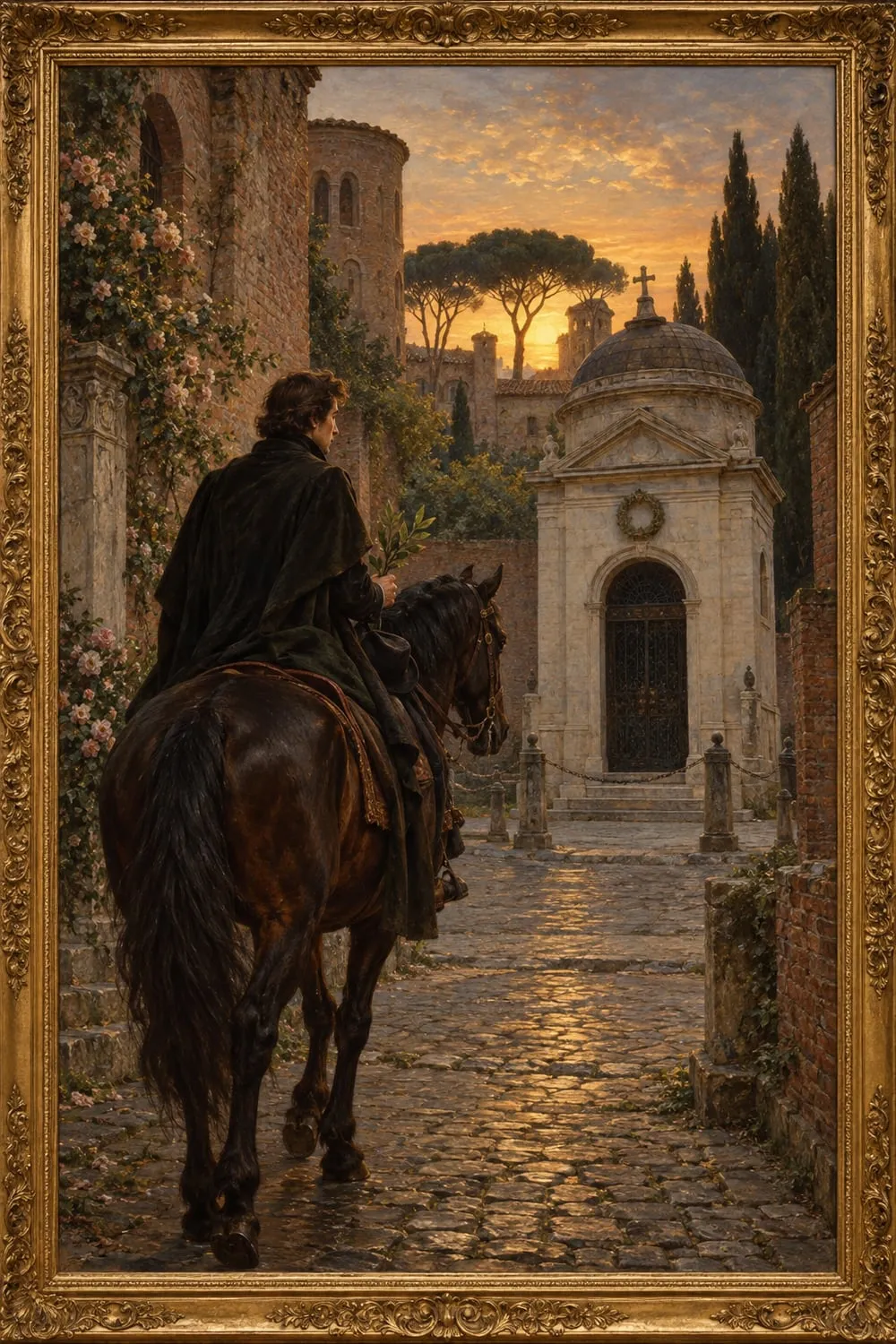
A young poet's tribute to a sleeping city
Ravenna
"Ravenna guards thine ashes: sleep in peace."
Poem
To My Friend George Fleming, Author of The Nile Novel and Mirage
I
A year ago I breathed the Italian air—And yet, methinks this northern Spring is fair—These fields made golden with the flower of March,The throstle singing on the feathered larch,The cawing rooks, the wood-doves fluttering by,The little clouds that race across the sky;And fair the violet’s gentle drooping head,The primrose, pale for love uncomforted,The rose that burgeons on the climbing briar,The crocus-bed, (that seems a moon of fireRound-girdled with a purple marriage-ring);And all the flowers of our English Spring,Fond snowdrops, and the bright-starred daffodil.Up starts the lark beside the murmuring mill,And breaks the gossamer-threads of early dew;And down the river, like a flame of blue,Keen as an arrow flies the water-king,While the brown linnets in the greenwood sing.A year ago!—it seems a little timeSince last I saw that lordly southern clime,Where flower and fruit to purple radiance blow,And like bright lamps the fabled apples glow.Full Spring it was—and by rich flowering vines,Dark olive-groves and noble forest-pines,I rode at will; the moist glad air was sweet,The white road rang beneath my horse’s feet,And musing on Ravenna’s ancient name,I watched the day till, marked with wounds of flame,The turquoise sky to burnished gold was turned.
O how my heart with boyish passion burned,When far away across the sedge and mereI saw that Holy City rising clear,Crowned with her crown of towers!—On and onI galloped, racing with the setting sun,And ere the crimson after-glow was passed,I stood within Ravenna’s walls at last!
II
How strangely still! no sound of life or joyStartles the air; no laughing shepherd-boyPipes on his reed, nor ever through the dayComes the glad sound of children at their play:O sad, and sweet, and silent! surely hereA man might dwell apart from troublous fear,Watching the tide of seasons as they flowFrom amorous Spring to Winter’s rain and snow,And have no thought of sorrow;—here, indeed,Are Lethe’s waters, and that fatal weedWhich makes a man forget his fatherland.
Ay! amid lotus-meadows dost thou stand,Like Proserpine, with poppy-laden head,Guarding the holy ashes of the dead.For though thy brood of warrior sons hath ceased,Thy noble dead are with thee!—they at leastAre faithful to thine honour:—guard them well,O childless city! for a mighty spell,To wake men’s hearts to dreams of things sublime,Are the lone tombs where rest the Great of Time.
III
Yon lonely pillar, rising on the plain,Marks where the bravest knight of France was slain—The Prince of chivalry, the Lord of war,Gaston de Foix: for some untimely starLed him against thy city, and he fell,As falls some forest-lion fighting well.Taken from life while life and love were new,He lies beneath God’s seamless veil of blue;Tall lance-like reeds wave sadly o’er his head,And oleanders bloom to deeper red,Where his bright youth flowed crimson on the ground.
Look farther north unto that broken mound—There, prisoned now within a lordly tombRaised by a daughter’s hand, in lonely gloom,Huge-limbed Theodoric, the Gothic king,Sleeps after all his weary conquering.Time hath not spared his ruin—wind and rainHave broken down his stronghold; and againWe see that Death is mighty lord of all,And king and clown to ashen dust must fall.
Mighty indeed their glory! yet to meBarbaric king, or knight of chivalry,Or the great queen herself, were poor and vain,Beside the grave where Dante rests from pain.His gilded shrine lies open to the air;And cunning sculptor’s hands have carven thereThe calm white brow, as calm as earliest morn,The eyes that flashed with passionate love and scorn,The lips that sang of Heaven and of Hell,The almond-face which Giotto drew so well,The weary face of Dante;—to this day,Here in his place of resting, far awayFrom Arno’s yellow waters, rushing downThrough the wide bridges of that fairy town,Where the tall tower of Giotto seems to riseA marble lily under sapphire skies!Alas! my Dante! thou hast known the painOf meaner lives—the exile’s galling chain,How steep the stairs within kings’ houses are,And all the petty miseries which marMan’s nobler nature with the sense of wrong.Yet this dull world is grateful for thy song;Our nations do thee homage—even she,That cruel queen of vine-clad Tuscany,Who bound with crown of thorns thy living brow,Hath decked thine empty tomb with laurels now,And begs in vain the ashes of her son.
O mightiest exile! all thy grief is done:Thy soul walks now beside thy Beatrice;Ravenna guards thine ashes: sleep in peace.
IV
How lone this palace is; how grey the walls!No minstrel now wakes echoes in these halls.The broken chain lies rusting on the door,And noisome weeds have split the marble floor:Here lurks the snake, and here the lizards runBy the stone lions blinking in the sun.Byron dwelt here in love and revelryFor two long years—a second Anthony,Who of the world another Actium made!—Yet suffered not his royal soul to fade,Or lyre to break, or lance to grow less keen,’Neath any wiles of an Egyptian queen.For from the East there came a mighty cry,And Greece stood up to fight for Liberty,And called him from Ravenna: never knightRode forth more nobly to wild scenes of fight!None fell more bravely on ensanguined field,Borne like a Spartan back upon his shield!O Hellas! Hellas! in thine hour of pride,Thy day of might, remember him who diedTo wrest from off thy limbs the trammelling chain:O Salamis! O lone Plataean plain!O tossing waves of wild Euboean sea!O wind-swept heights of lone Thermopylae!He loved you well—ay, not alone in word,Who freely gave to thee his lyre and sword,Like Aeschylos at well-fought Marathon:
And England, too, shall glory in her son,Her warrior-poet, first in song and fight.No longer now shall Slander’s venomed spiteCrawl like a snake across his perfect name,Or mar the lordly scutcheon of his fame.
For as the olive-garland of the race,Which lights with joy each eager runner’s face,As the red cross which saveth men in war,As a flame-bearded beacon seen from farBy mariners upon a storm-tossed sea—Such was his love for Greece and Liberty!
Byron, thy crowns are ever fresh and green:Red leaves of rose from Sapphic MityleneShall bind thy brows; the myrtle blooms for thee,In hidden glades by lonely Castaly;The laurels wait thy coming: all are thine,And round thy head one perfect wreath will twine.
V
The pine-tops rocked before the evening breezeWith the hoarse murmur of the wintry seas,And the tall stems were streaked with amber bright;—I wandered through the wood in wild delight,Some startled bird, with fluttering wings and fleet,Made snow of all the blossoms; at my feet,Like silver crowns, the pale narcissi lay,And small birds sang on every twining spray.O waving trees, O forest liberty!Within your haunts at least a man is free,And half forgets the weary world of strife:The blood flows hotter, and a sense of lifeWakes i’ the quickening veins, while once againThe woods are filled with gods we fancied slain.Long time I watched, and surely hoped to seeSome goat-foot Pan make merry minstrelsyAmid the reeds! some startled Dryad-maidIn girlish flight! or lurking in the glade,The soft brown limbs, the wanton treacherous faceOf woodland god! Queen Dian in the chase,White-limbed and terrible, with look of pride,And leash of boar-hounds leaping at her side!Or Hylas mirrored in the perfect stream.
O idle heart! O fond Hellenic dream!Ere long, with melancholy rise and swell,The evening chimes, the convent’s vesper bell,Struck on mine ears amid the amorous flowers.Alas! alas! these sweet and honied hoursHad whelmed my heart like some encroaching sea,And drowned all thoughts of black Gethsemane.
VI
O lone Ravenna! many a tale is toldOf thy great glories in the days of old:Two thousand years have passed since thou didst seeCaesar ride forth to royal victory.Mighty thy name when Rome’s lean eagles flewFrom Britain’s isles to far Euphrates blue;And of the peoples thou wast noble queen,Till in thy streets the Goth and Hun were seen.Discrowned by man, deserted by the sea,Thou sleepest, rocked in lonely misery!No longer now upon thy swelling tide,Pine-forest-like, thy myriad galleys ride!For where the brass-beaked ships were wont to float,The weary shepherd pipes his mournful note;And the white sheep are free to come and goWhere Adria’s purple waters used to flow.
O fair! O sad! O Queen uncomforted!In ruined loveliness thou liest dead,Alone of all thy sisters; for at lastItalia’s royal warrior hath passedRome’s lordliest entrance, and hath worn his crownIn the high temples of the Eternal Town!The Palatine hath welcomed back her king,And with his name the seven mountains ring!
And Naples hath outlived her dream of pain,And mocks her tyrant! Venice lives again,New risen from the waters! and the cryOf Light and Truth, of Love and Liberty,Is heard in lordly Genoa, and whereThe marble spires of Milan wound the air,Rings from the Alps to the Sicilian shore,And Dante’s dream is now a dream no more.
But thou, Ravenna, better loved than all,Thy ruined palaces are but a pallThat hides thy fallen greatness! and thy nameBurns like a grey and flickering candle-flameBeneath the noonday splendour of the sunOf new Italia! for the night is done,The night of dark oppression, and the dayHath dawned in passionate splendour: far awayThe Austrian hounds are hunted from the land,Beyond those ice-crowned citadels which standGirdling the plain of royal Lombardy,From the far West unto the Eastern sea.
I know, indeed, that sons of thine have diedIn Lissa’s waters, by the mountain-sideOf Aspromonte, on Novara’s plain—Nor have thy children died for thee in vain:And yet, methinks, thou hast not drunk this wineFrom grapes new-crushed of Liberty divine,Thou hast not followed that immortal StarWhich leads the people forth to deeds of war.Weary of life, thou liest in silent sleep,As one who marks the lengthening shadows creep,Careless of all the hurrying hours that run,Mourning some day of glory, for the sunOf Freedom hath not shown to thee his face,And thou hast caught no flambeau in the race.
Yet wake not from thy slumbers—rest thee well,Amidst thy fields of amber asphodel,Thy lily-sprinkled meadows—rest thee there,To mock all human greatness: who would dareTo vent the paltry sorrows of his lifeBefore thy ruins, or to praise the strifeOf kings’ ambition, and the barren prideOf warring nations! wert not thou the BrideOf the wild Lord of Adria’s stormy sea!The Queen of double Empires! and to theeWere not the nations given as thy prey!And now—thy gates lie open night and day,The grass grows green on every tower and hall,The ghastly fig hath cleft thy bastioned wall;And where thy mailèd warriors stood at restThe midnight owl hath made her secret nest.O fallen! fallen! from thy high estate,O city trammelled in the toils of Fate,Doth nought remain of all thy glorious days,But a dull shield, a crown of withered bays!
Yet who beneath this night of wars and fears,From tranquil tower can watch the coming years;Who can foretell what joys the day shall bring,Or why before the dawn the linnets sing?Thou, even thou, mayst wake, as wakes the roseTo crimson splendour from its grave of snows;As the rich corn-fields rise to red and goldFrom these brown lands, now stiff with Winter’s cold;As from the storm-rack comes a perfect star!
O much-loved city! I have wandered farFrom the wave-circled islands of my home;Have seen the gloomy mystery of the DomeRise slowly from the drear Campagna’s way,Clothed in the royal purple of the day:I from the city of the violet crownHave watched the sun by Corinth’s hill go down,And marked the “myriad laughter” of the seaFrom starlit hills of flower-starred Arcady;Yet back to thee returns my perfect love,As to its forest-nest the evening dove.
O poet’s city! one who scarce has seenSome twenty summers cast their doublets green,For Autumn’s livery, would seek in vainTo wake his lyre to sing a louder strain,Or tell thy days of glory;—poor indeedIs the low murmur of the shepherd’s reed,Where the loud clarion’s blast should shake the sky,And flame across the heavens! and to trySuch lofty themes were folly: yet I knowThat never felt my heart a nobler glowThan when I woke the silence of thy streetWith clamorous trampling of my horse’s feet,And saw the city which now I try to sing,After long days of weary travelling.
VII
Adieu, Ravenna! but a year ago,I stood and watched the crimson sunset glowFrom the lone chapel on thy marshy plain:The sky was as a shield that caught the stainOf blood and battle from the dying sun,And in the west the circling clouds had spunA royal robe, which some great God might wear,While into ocean-seas of purple airSank the gold galley of the Lord of Light.
Yet here the gentle stillness of the nightBrings back the swelling tide of memory,And wakes again my passionate love for thee:Now is the Spring of Love, yet soon will comeOn meadow and tree the Summer’s lordly bloom;And soon the grass with brighter flowers will blow,And send up lilies for some boy to mow.Then before long the Summer’s conqueror,Rich Autumn-time, the season’s usurer,Will lend his hoarded gold to all the trees,And see it scattered by the spendthrift breeze;And after that the Winter cold and drear.So runs the perfect cycle of the year.And so from youth to manhood do we go,And fall to weary days and locks of snow.Love only knows no winter; never dies:Nor cares for frowning storms or leaden skies.And mine for thee shall never pass away,Though my weak lips may falter in my lay.
Adieu! Adieu! yon silent evening star,The night’s ambassador, doth gleam afar,And bid the shepherd bring his flocks to fold.Perchance before our inland seas of goldAre garnered by the reapers into sheaves,Perchance before I see the Autumn leaves,I may behold thy city; and lay downLow at thy feet the poet’s laurel crown.
Adieu! Adieu! yon silver lamp, the moon,Which turns our midnight into perfect noon,Doth surely light thy towers, guarding wellWhere Dante sleeps, where Byron loved to dwell.
In brief
SummaryA long poem in seven parts, written in rhyming couplets, in which the speaker, back in an English spring, remembers riding into Ravenna a year before. The city is silent and forsaken, a guardian of the great dead: the pillar of Gaston de Foix, the tomb of Theodoric and, above all, the grave of Dante. The speaker praises Byron, who lived there before leaving to die for Greek liberty, dreams of the old gods in the pine woods, and mourns that Ravenna sleeps while the rest of Italy wakes to freedom. The poem ends in farewell, with a hope to return and lay the poet's laurel at the city's feet.
Key themes
"I stood within Ravenna's walls at last!"
Related works
Explore more of Wilde's writing The Ballad of Reading GaolWritten after his release from prison, a long ballad about the hanging of a fellow prisoner, a trooper who had killed his wife. Wilde's last work, and his most read poem.Read more
  The SphinxA student in his room questions the ancient sphinx that has watched from its corner for a thousand years, and is frightened by what she knows.Read more
 Summary
In an English March, among larks, primroses and daffodils, the speaker recalls that 'A year ago I breathed the Italian air'. Riding through vines and olive groves in full spring, musing on 'Ravenna's ancient name', he saw at sunset 'that Holy City rising clear', galloped on against the setting sun and 'stood within Ravenna's walls at last!' Part II finds the city strangely still, with no shepherd piping and no children at play, a place of 'Lethe's waters' where a man might forget sorrow. Like Proserpine among lotus meadows, the 'childless city' guards 'the holy ashes of the dead'.
Part III walks among those dead. A lonely pillar marks where Gaston de Foix, 'the bravest knight of France', fell attacking the city; to the north, in a tomb raised by his daughter, 'Huge-limbed Theodoric, the Gothic king' sleeps in a ruin that proves 'Death is mighty lord of all'. Greater than knight or king is Dante, whose carved shrine keeps 'The eyes that flashed with passionate love and scorn'. The speaker pities his exile from the city of the Arno, which crowned him with thorns and now 'begs in vain the ashes of her son', and bids him sleep in peace beside his Beatrice.
Part IV visits a grey, ruined palace where Byron 'dwelt here in love and revelry / For two long years', until Greece rose 'to fight for Liberty' and called him away to die 'like a Spartan'. The speaker asks Greece to remember him, trusts that England will clear his name of slander, and crowns him with rose, myrtle and laurel. In part V, walking in the pine woods at evening, the speaker half hopes to glimpse Pan, a Dryad, Diana hunting or Hylas in the stream, until the convent's vesper bell recalls 'black Gethsemane' and ends the 'fond Hellenic dream'.
Part VI recalls the city's past, when Caesar rode out and fleets filled its harbour, before the Goth and Hun came and the sea withdrew, so that sheep now graze where galleys floated. The rest of Italy has woken: a king is crowned in Rome, Naples, Venice, Genoa and Milan ring with liberty, and 'Dante's dream is now a dream no more'. Ravenna alone sleeps, its gates open, a fig splitting its walls and an owl nesting where its warriors stood. The speaker bids her rest, yet hopes she may wake like a rose from snow, and declares that after all his wanderings his love still returns to her, though at barely twenty his reed is too weak to sing her glories.
Part VII says farewell. The speaker recalls a crimson sunset watched from a lone chapel on the marshy plain, then traces the turning year from spring to winter, as youth turns to age: only love 'knows no winter'. Under the evening star and the moon, he hopes to see the city again before autumn and lay 'the poet's laurel crown' at its feet, where 'Dante sleeps, where Byron loved to dwell'.
Characters
The speaker
The young poet-traveller
A traveller of barely twenty, who writes in an English spring of the evening, a year before, when he galloped into Ravenna at sunset. He has wandered 'far / From the wave-circled islands of my home', through Italy and Greece, yet his love returns to Ravenna, and he hopes to lay a poet's laurel at her feet.
Ravenna
The sleeping queen city
The city itself, addressed as a living figure: once 'noble queen' of peoples and 'the Bride / Of the wild Lord of Adria's stormy sea', now 'childless', 'deserted by the sea' and asleep among its ruins. She guards the ashes of the great dead, and the speaker hopes she may yet wake 'as wakes the rose'.
Dante
The mightiest exile
The poet whose grave matters to the speaker more than any king's or knight's. His carved shrine shows 'The calm white brow' and 'The lips that sang of Heaven and of Hell'. Exiled from his city on the Arno, which now begs for his ashes in vain, he rests in Ravenna while his soul walks beside Beatrice.
Byron
The warrior-poet
The English poet who lived in a now-ruined Ravenna palace 'in love and revelry / For two long years', until Greece rose to fight for liberty and called him away. He died bravely, 'like a Spartan', and the speaker asks Greece to remember him and trusts England to clear his name of slander.
Gaston de Foix
The bravest knight of France
'The Prince of chivalry, the Lord of war', led against Ravenna by 'some untimely star'. He fell 'As falls some forest-lion fighting well', and a lonely pillar on the plain marks the place, with reeds waving over him and oleanders blooming red where his blood was shed.
Theodoric
The Gothic king
'Huge-limbed Theodoric', who sleeps after 'all his weary conquering' in a lordly tomb raised by his daughter, to the north of the city. Wind and rain have broken down his stronghold, and his ruined tomb teaches that 'Death is mighty lord of all'.
Themes
The city of the dead
Ravenna is praised less for its life than for its tombs. It is a 'childless city' guarding 'the holy ashes of the dead', and its treasures are the graves of Gaston de Foix, Theodoric and Dante, 'the lone tombs where rest the Great of Time'. Its ruin, with 'The ghastly fig' cleaving its wall and the owl nesting where warriors stood, is itself a lesson 'To mock all human greatness'.
Poets and liberty
Dante and Byron are the poem's heroes, and both are tied to freedom. Dante, the 'mightiest exile', is honoured now that 'Dante's dream is now a dream no more' in a free Italy. Byron leaves Ravenna when 'Greece stood up to fight for Liberty', and his love for Greece shines like 'a flame-bearded beacon'. The young speaker hopes to follow them by laying 'the poet's laurel crown' at the city's feet.
Pagan dream and Christian memory
In the pine woods of part V the speaker longs to see 'goat-foot Pan', a 'Dryad-maid', 'Queen Dian in the chase' and Hylas, as 'The woods are filled with gods we fancied slain'. The convent bell breaks the spell: 'O idle heart! O fond Hellenic dream!' The 'sweet and honied hours' have 'drowned all thoughts of black Gethsemane', a pull between Greek and Christian that the poem admits without settling.
Memory and the turning year
The poem is framed by time. It begins 'A year ago' in an English spring and ends by tracing the seasons from spring to 'the Winter cold and drear', as youth falls 'to weary days and locks of snow'. Against this cycle the speaker sets one exception: 'Love only knows no winter; never dies'. Memory keeps Ravenna present across the year and the distance.
Context
Ravenna won the Newdigate Prize at Oxford in 1878. It is dedicated 'To My Friend George Fleming, Author of The Nile Novel and Mirage'. The poem is written in rhyming couplets and divided into seven numbered parts, and its speaker calls himself one who has seen barely 'twenty summers'. Some of its lines appear elsewhere among the poems: the sunset sky 'marked with wounds of flame' recurs almost word for word in 'Sonnet on Approaching Italy'.
About this edition
- Text: the complete work from Standard Ebooks, released into the public domain (CC0 1.0). We change only the layout.
- Download the EPUB of the whole book it comes from, free, for any e-reader.
- Every quotation and glossary word in these notes is checked against the text.