Rome's glory, from sword to shepherd
Urbs Sacra Aeterna
"The prisoned shepherd of the Church of God."
Poem
Rome! what a scroll of History thine has been;In the first days thy sword republicanRuled the whole world for many an age’s span:Then of the peoples wert thou royal Queen,Till in thy streets the bearded Goth was seen;And now upon thy walls the breezes fan(Ah, city crowned by God, discrowned by man!)The hated flag of red and white and green.When was thy glory! when in search for powerThine eagles flew to greet the double sun,And the wild nations shuddered at thy rod?Nay, but thy glory tarried for this hour,When pilgrims kneel before the Holy One,The prisoned shepherd of the Church of God.
Montre Mario.
In brief
SummaryThe speaker unrolls the history of Rome like a scroll: the republic whose sword ruled the world, the imperial city that was queen of the peoples, the fall when the Goths walked its streets, and the present, when 'The hated flag of red and white and green' flies on its walls. He asks when Rome's true glory was, in the age of conquest when its eagles flew and nations trembled. His answer is the present hour, when pilgrims kneel before the Pope, 'The prisoned shepherd of the Church of God'.
Key themes
"Rome! what a scroll of History thine has been;"
Summary
The sonnet opens by treating Rome's past as 'a scroll of History'. In the first days its 'sword republican' ruled the whole world 'for many an age's span'; then Rome became 'royal Queen' of the peoples; then 'the bearded Goth' was seen in its streets. The first eight lines end in the present, where the breezes lift 'The hated flag of red and white and green' over the walls, and the speaker breaks in with a bracketed cry: 'Ah, city crowned by God, discrowned by man!'
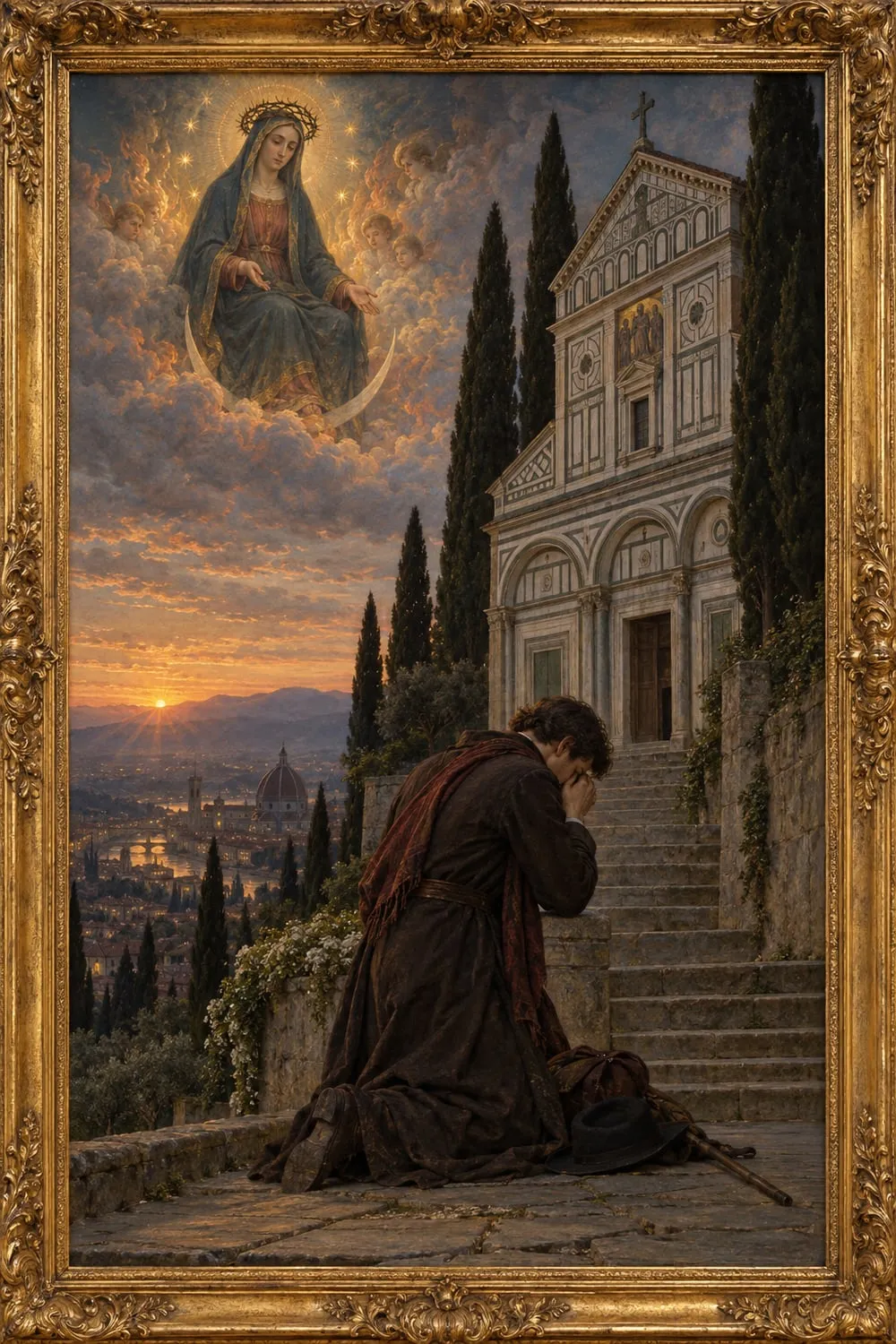
The last six lines ask where Rome's glory truly lay. Was it when, 'in search for power', its eagles flew 'to greet the double sun', and 'the wild nations shuddered at thy rod'? The answer is 'Nay'. Rome's glory 'tarried for this hour', the present moment 'When pilgrims kneel before the Holy One, The prisoned shepherd of the Church of God'.
The poem reverses the usual measure of greatness. It finds Rome's high point not in conquest but in a captive pastor and the pilgrims who come to him.
Characters
Rome
The eternal city
The city itself, addressed through the whole sonnet as 'thou'. It has been a republic ruling the world, a 'royal Queen' and a victim of the Goths, and is now a 'city crowned by God, discrowned by man', with a hated flag on its walls.
The Pope
The prisoned shepherd
The 'Holy One' before whom pilgrims kneel, called 'The prisoned shepherd of the Church of God'. He has no army or eagles, only the devotion of pilgrims, and the speaker declares that Rome's glory has waited for him.
Themes
Earthly and spiritual greatness
The first half runs through the kinds of glory history usually praises: the republic's sword, the imperial crown, 'Thine eagles' and the 'rod' that made nations shudder. The second half dismisses them with 'Nay'. True glory 'tarried for this hour', when pilgrims kneel to a shepherd who is a prisoner. Devotion replaces power, and weakness replaces conquest, as the measure of the city.
A city crowned and discrowned
The bracketed line 'Ah, city crowned by God, discrowned by man!' carries the poem's grief. 'The hated flag of red and white and green' stands for the men who have taken the city from its sacred ruler. The same flag appears in Italia, from the same group, as the proud banner of Italy's fleets; here it is an insult flying on the walls of a holy place.
History as a scroll
The opening image, 'what a scroll of History thine has been', lets the poem pass through centuries in eight lines: republic, empire, Gothic invasion, the present. Each age replaces the last, and the speaker reads them as stages leading to 'this hour'. History has a direction for him, and it ends with pilgrims kneeling before 'the Holy One'.
Context
Urbs Sacra Aeterna, Latin for 'the holy eternal city', is a sonnet in the Rosa Mystica group of Wilde's Poems (1881). The place name at its foot, printed 'Montre Mario', is Monte Mario, the hill overlooking Rome. The 'prisoned shepherd' reflects the position of the Pope after Italian troops took Rome in 1870, when he refused to leave the Vatican and called himself its prisoner.
About this edition
- Text: the complete work from Standard Ebooks, released into the public domain (CC0 1.0). We change only the layout.
- Download the EPUB of the whole book it comes from, free, for any e-reader.
- Every quotation and glossary word in these notes is checked against the text.