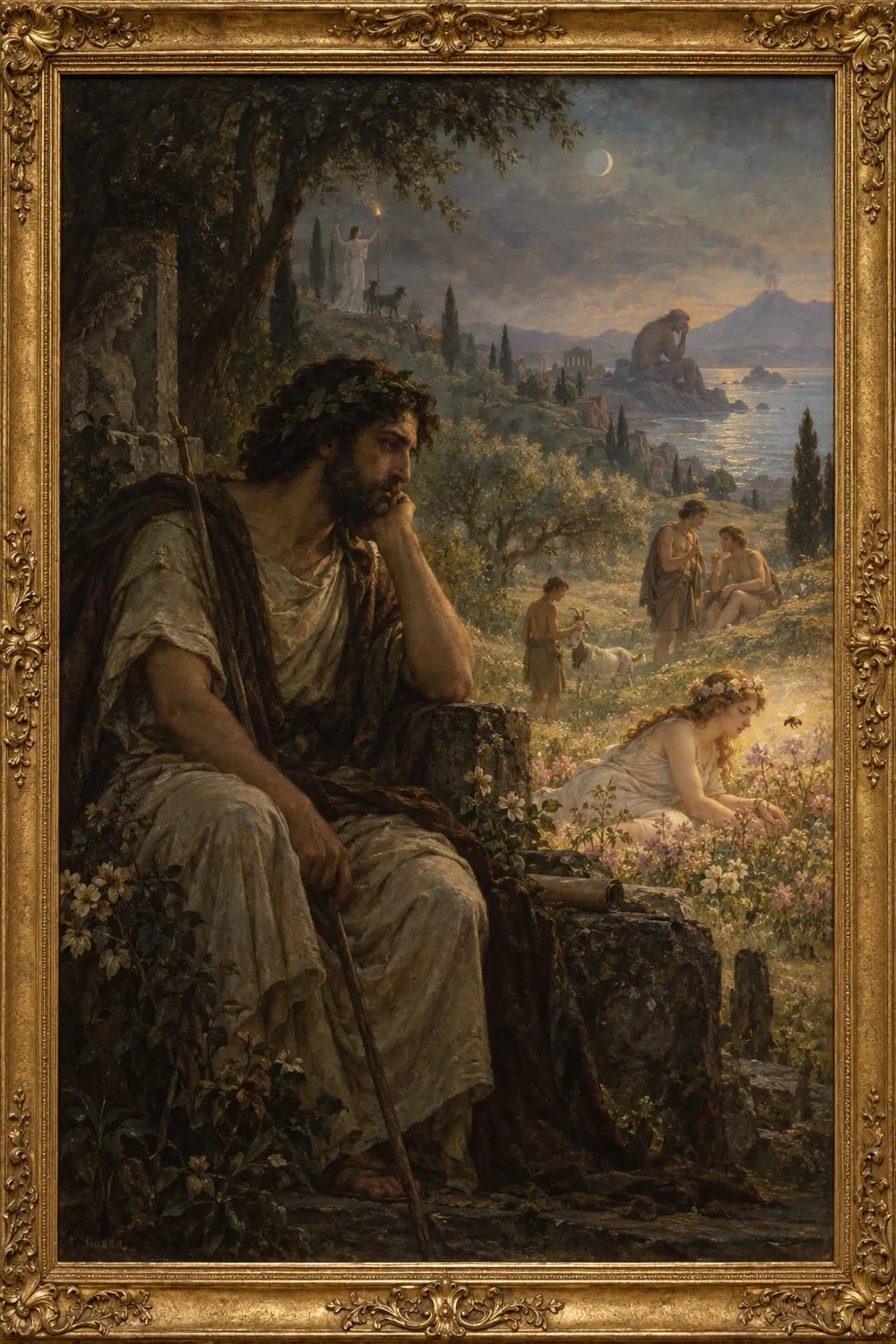
To the shepherd poet of Sicily
Theocritus
"Dost thou remember Sicily?"
Poem
A Villanelle
O singer of Persephone!In the dim meadows desolateDost thou remember Sicily?
Still through the ivy flits the beeWhere Amaryllis lies in state;O Singer of Persephone!
Simaetha calls on HecateAnd hears the wild dogs at the gate;Dost thou remember Sicily?
Still by the light and laughing seaPoor Polypheme bemoans his fate;O Singer of Persephone!
And still in boyish rivalryYoung Daphnis challenges his mate;Dost thou remember Sicily?
Slim Lacon keeps a goat for thee,For thee the jocund shepherds wait;O Singer of Persephone!Dost thou remember Sicily?
In brief
SummaryThe speaker addresses Theocritus, the Greek poet of Sicilian shepherds, now among the dead 'In the dim meadows desolate', and asks whether he still remembers Sicily. Each stanza answers with a scene from his poems that goes on without him: the bee still flits where Amaryllis lies, Simaetha calls on Hecate, Polypheme mourns by the sea, young Daphnis challenges his friend, and Lacon keeps a goat for the poet. The two refrains, 'O singer of Persephone!' and 'Dost thou remember Sicily?', alternate through the poem and join at the end.
Key themes
"O singer of Persephone!"
Summary
The subtitle names the form, a villanelle: five three-line stanzas and a final four-line one, with two refrains that alternate and come together at the close. The first stanza addresses the poet as 'singer of Persephone', the queen of the underworld, and asks him, in 'the dim meadows desolate' where the dead now keep him, 'Dost thou remember Sicily?'
The middle stanzas bring back the people of his pastoral world as if their stories were still going on. 'Still through the ivy flits the bee Where Amaryllis lies in state'. Simaetha 'calls on Hecate And hears the wild dogs at the gate'. By 'the light and laughing sea', 'Poor Polypheme bemoans his fate', and 'Young Daphnis challenges his mate' in 'boyish rivalry'.
The last stanza turns to the poet himself: 'Slim Lacon keeps a goat for thee, For thee the jocund shepherds wait'. The final two lines join the refrains, and the question is left unanswered.
Characters
Theocritus
The singer of Persephone
The Greek pastoral poet, named only in the title, whom the speaker imagines among the dead in 'the dim meadows desolate'. The people of his poems, Amaryllis, Simaetha, Polypheme, Daphnis and Lacon, still live out their stories in Sicily and wait for him.
Themes
Poetry that outlives the poet
Theocritus is among the dead, in 'the dim meadows desolate', yet the figures he created are 'Still' alive: the bee flits where Amaryllis lies, Polypheme 'bemoans his fate', Daphnis 'challenges his mate'. The repeated 'still' shows the poems going on without their maker. The question 'Dost thou remember Sicily?' turns the usual order round: the world remembers him, and it is he who might forget.
Pastoral longing
The Sicily of the poem is a shepherd's paradise of ivy and bees, a 'light and laughing sea', singing contests and 'jocund shepherds'. It is set against the grey meadows of the dead. The last stanza makes the pull personal: 'Slim Lacon keeps a goat for thee, For thee the jocund shepherds wait'. The happy country waits for a poet who cannot come back.
Refrain as memory
The villanelle repeats its two refrains, 'O singer of Persephone!' and 'Dost thou remember Sicily?', until they meet in the last lines. The repetition suits a poem about remembering: the question is asked again and again, like a call into silence. Only two rhyme sounds run through the whole poem, so it stays as narrow and insistent as the question.
Quotes
"O singer of Persephone!"
The poem
"Poor Polypheme bemoans his fate;"
The poem
"Dost thou remember Sicily?"
The poem
Context
Theocritus, subtitled A Villanelle, appears in the Flowers of Gold group of Wilde's Poems (1881). Theocritus was the ancient Greek poet of Sicilian shepherd life whose pastoral poems are known as the Idylls, and Amaryllis, Simaetha, Polyphemus, Daphnis and Lacon are all figures from them. The villanelle is a French form of nineteen lines built on two refrains and two rhymes.
About this edition
- Text: the complete work from Standard Ebooks, released into the public domain (CC0 1.0). We change only the layout.
- Download the EPUB of the whole book it comes from, free, for any e-reader.
- Every quotation and glossary word in these notes is checked against the text.