A beggar, a sovereign and a wedding present
The Model Millionaire
"Romance is the privilege of the rich, not the profession of the unemployed."
Story · Lord Arthur Savile's Crime and Other Stories
Listen · 14 min
Read by Alex Lau for LibriVox. Public domain.
A Note of Admiration
Unless one is wealthy there is no use in being a charming fellow. Romance is the privilege of the rich, not the profession of the unemployed. The poor should be practical and prosaic. It is better to have a permanent income than to be fascinating. These are the great truths of modern life which Hughie Erskine never realised. Poor Hughie! Intellectually, we must admit, he was not of much importance. He never said a brilliant or even an ill-natured thing in his life. But then he was wonderfully good-looking, with his crisp brown hair, his clear-cut profile, and his grey eyes. He was as popular with men as he was with women and he had every accomplishment except that of making money. His father had bequeathed him his cavalry sword and a History of the Peninsular War in fifteen volumes. Hughie hung the first over his looking-glass, put the second on a shelf between Ruff’s Guide and Bailey’s Magazine, and lived on two hundred a year that an old aunt allowed him. He had tried everything. He had gone on the Stock Exchange for six months; but what was a butterfly to do among bulls and bears? He had been a tea-merchant for a little longer, but had soon tired of pekoe and souchong. Then he had tried selling dry sherry. That did not answer; the sherry was a little too dry. Ultimately he became nothing, a delightful, ineffectual young man with a perfect profile and no profession.
To make matters worse, he was in love. The girl he loved was Laura Merton, the daughter of a retired Colonel who had lost his temper and his digestion in India, and had never found either of them again. Laura adored him, and he was ready to kiss her shoestrings. They were the handsomest couple in London, and had not a penny-piece between them. The Colonel was very fond of Hughie, but would not hear of any engagement.
“Come to me, my boy, when you have got ten thousand pounds of your own, and we will see about it,” he used to say; and Hughie looked very glum in those days, and had to go to Laura for consolation.
One morning, as he was on his way to Holland Park, where the Mertons lived, he dropped in to see a great friend of his, Alan Trevor. Trevor was a painter. Indeed, few people escape that nowadays. But he was also an artist, and artists are rather rare. Personally he was a strange rough fellow, with a freckled face and a red ragged beard. However, when he took up the brush he was a real master, and his pictures were eagerly sought after. He had been very much attracted by Hughie at first, it must be acknowledged, entirely on account of his personal charm. “The only people a painter should know,” he used to say, “are people who are bête and beautiful, people who are an artistic pleasure to look at and an intellectual repose to talk to. Men who are dandies and women who are darlings rule the world, at least they should do so.” However, after he got to know Hughie better, he liked him quite as much for his bright, buoyant spirits and his generous, reckless nature, and had given him the permanent entrée to his studio.
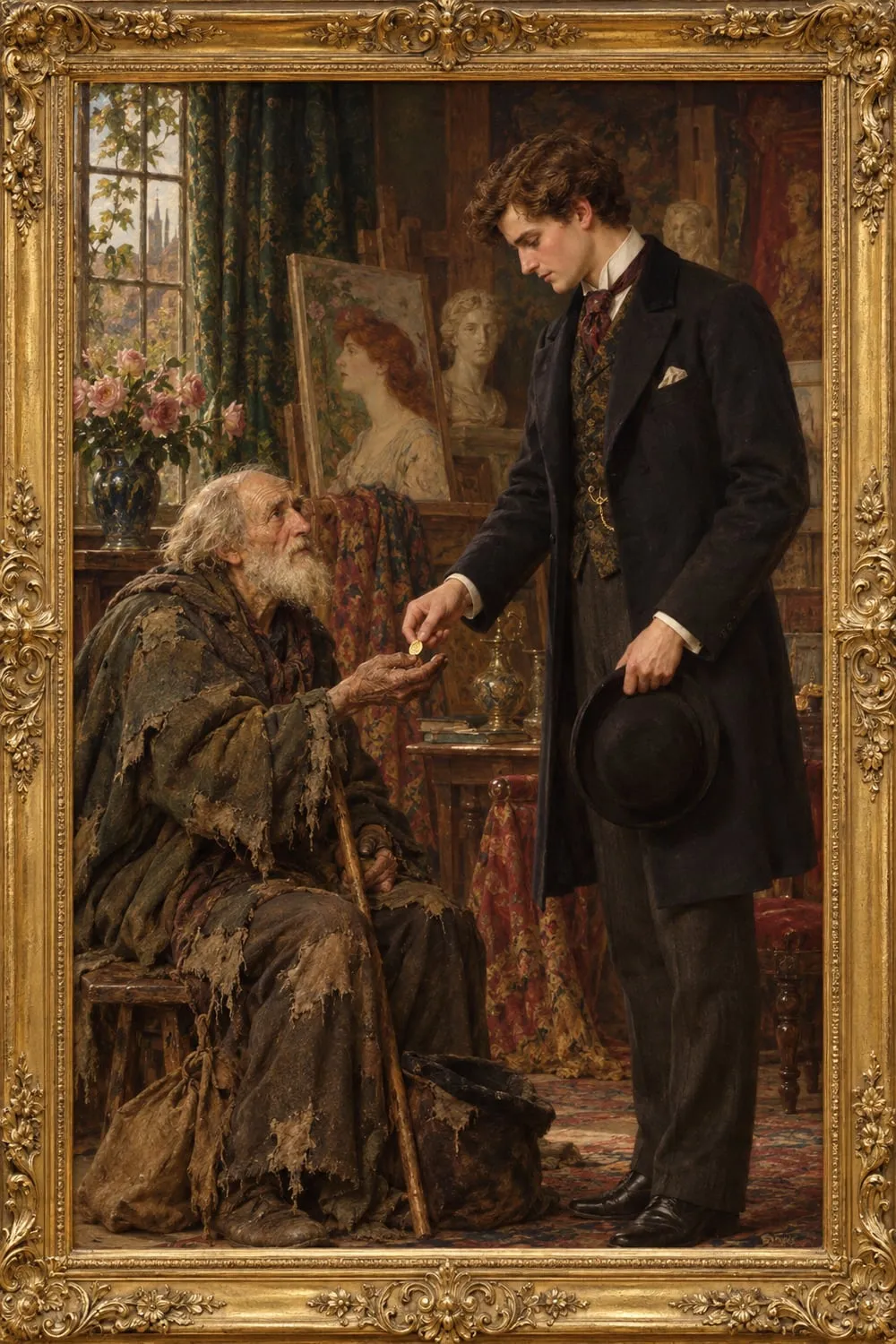
When Hughie came in he found Trevor putting the finishing touches to a wonderful life-size picture of a beggar-man. The beggar himself was standing on a raised platform in a corner of the studio. He was a wizened old man, with a face like wrinkled parchment, and a most piteous expression. Over his shoulders was flung a coarse brown cloak, all tears and tatters; his thick boots were patched and cobbled, and with one hand he leant on a rough stick, while with the other he held out his battered hat for alms.
“What an amazing model!” whispered Hughie, as he shook hands with his friend.
“An amazing model?” shouted Trevor at the top of his voice; “I should think so! Such beggars as he are not to be met with every day. A trouvaille, mon cher; a living Velasquez! My stars! what an etching Rembrandt would have made of him!”
“Poor old chap!” said Hughie, “how miserable he looks! But I suppose, to you painters, his face is his fortune?”
“Certainly,” replied Trevor, “you don’t want a beggar to look happy, do you?”
“How much does a model get for sitting?” asked Hughie, as he found himself a comfortable seat on a divan.
“A shilling an hour.”
“And how much do you get for your picture, Alan?”
“Oh, for this I get two thousand!”
“Pounds?”
“Guineas. Painters, poets, and physicians always get guineas.”
“Well, I think the model should have a percentage,” cried Hughie, laughing; “they work quite as hard as you do.”
“Nonsense, nonsense! Why, look at the trouble of laying on the paint alone, and standing all day long at one’s easel! It’s all very well, Hughie, for you to talk, but I assure you that there are moments when Art almost attains to the dignity of manual labour. But you mustn’t chatter; I’m very busy. Smoke a cigarette, and keep quiet.”
After some time the servant came in, and told Trevor that the framemaker wanted to speak to him.
“Don’t run away, Hughie,” he said, as he went out, “I will be back in a moment.”
The old beggar-man took advantage of Trevor’s absence to rest for a moment on a wooden bench that was behind him. He looked so forlorn and wretched that Hughie could not help pitying him, and felt in his pockets to see what money he had. All he could find was a sovereign and some coppers. “Poor old fellow,” he thought to himself, “he wants it more than I do, but it means no hansoms for a fortnight,” and he walked across the studio and slipped the sovereign into the beggar’s hand.
The old man started, and a faint smile flitted across his withered lips. “Thank you, sir,” he said, “thank you.”
Then Trevor arrived, and Hughie took his leave, blushing a little at what he had done. He spent the day with Laura, got a charming scolding for his extravagance, and had to walk home.
That night he strolled into the Palette Club about eleven o’clock, and found Trevor sitting by himself in the smoking-room drinking hock and seltzer.
“Well, Alan, did you get the picture finished all right?” he said, as he lit his cigarette.
“Finished and framed, my boy!” answered Trevor; “and, by the by, you have made a conquest. That old model you saw is quite devoted to you. I had to tell him all about you—who you are, where you live, what your income is, what prospects you have—”
“My dear Alan,” cried Hughie, “I shall probably find him waiting for me when I go home. But of course you are only joking. Poor old wretch! I wish I could do something for him. I think it is dreadful that anyone should be so miserable. I have got heaps of old clothes at home—do you think he would care for any of them? Why, his rags were falling to bits.”
“But he looks splendid in them,” said Trevor. “I wouldn’t paint him in a frock coat for anything. What you call rags I call romance. What seems poverty to you is picturesqueness to me. However, I’ll tell him of your offer.”
“Alan,” said Hughie seriously, “you painters are a heartless lot.”
“An artist’s heart is his head,” replied Trevor; “and besides, our business is to realise the world as we see it, not to reform it as we know it. À chacun son métier. And now tell me how Laura is. The old model was quite interested in her.”
“You don’t mean to say you talked to him about her?” said Hughie.
“Certainly I did. He knows all about the relentless colonel, the lovely Laura, and the £10,000.”
“You told that old beggar all my private affairs?” cried Hughie, looking very red and angry.
“My dear boy,” said Trevor, smiling, “that old beggar, as you call him, is one of the richest men in Europe. He could buy all London tomorrow without overdrawing his account. He has a house in every capital, dines off gold plate, and can prevent Russia going to war when he chooses.”
“What on earth do you mean?” exclaimed Hughie.
“What I say,” said Trevor. “The old man you saw today in the studio was Baron Hausberg. He is a great friend of mine, buys all my pictures and that sort of thing, and gave me a commission a month ago to paint him as a beggar. Que voulez-vous? La fantaisie d’un millionaire! And I must say he made a magnificent figure in his rags, or perhaps I should say in my rags; they are an old suit I got in Spain.”
“Baron Hausberg!” cried Hughie. “Good heavens! I gave him a sovereign!” and he sank into an armchair the picture of dismay.
“Gave him a sovereign!” shouted Trevor, and he burst into a roar of laughter. “My dear boy, you’ll never see it again. Son affaire c’est l’argent des autres.”
“I think you might have told me, Alan,” said Hughie sulkily, “and not have let me make such a fool of myself.”
“Well, to begin with, Hughie,” said Trevor, “it never entered my mind that you went about distributing alms in that reckless way. I can understand your kissing a pretty model, but your giving a sovereign to an ugly one—by Jove, no! Besides, the fact is that I really was not at home today to anyone; and when you came in I didn’t know whether Hausberg would like his name mentioned. You know he wasn’t in full dress.”
“What a duffer he must think me!” said Hughie.
“Not at all. He was in the highest spirits after you left; kept chuckling to himself and rubbing his old wrinkled hands together. I couldn’t make out why he was so interested to know all about you; but I see it all now. He’ll invest your sovereign for you, Hughie, pay you the interest every six months, and have a capital story to tell after dinner.”
“I am an unlucky devil,” growled Hughie. “The best thing I can do is to go to bed; and, my dear Alan, you mustn’t tell anyone. I shouldn’t dare show my face in the Row.”
“Nonsense! It reflects the highest credit on your philanthropic spirit, Hughie. And don’t run away. Have another cigarette, and you can talk about Laura as much as you like.”
However, Hughie wouldn’t stop, but walked home, feeling very unhappy, and leaving Alan Trevor in fits of laughter.
The next morning, as he was at breakfast, the servant brought him up a card on which was written, “Monsieur Gustave Naudin, de la part de M. le Baron Hausberg.” “I suppose he has come for an apology,” said Hughie to himself; and he told the servant to show the visitor up.
An old gentleman with gold spectacles and grey hair came into the room, and said, in a slight French accent, “Have I the honour of addressing Monsieur Erskine?”
Hughie bowed.
“I have come from Baron Hausberg,” he continued. “The Baron—”
“I beg, sir, that you will offer him my sincerest apologies,” stammered Hughie.
“The Baron,” said the old gentleman with a smile, “has commissioned me to bring you this letter,” and he extended a sealed envelope.
On the outside was written, “A wedding present to Hugh Erskine and Laura Merton, from an old beggar,” and inside was a cheque for £10,000.
When they were married Alan Trevor was the best man, and the Baron made a speech at the wedding breakfast.
“Millionaire models,” remarked Alan, “are rare enough; but, by Jove, model millionaires are rarer still!”
The story in brief
SummaryHughie Erskine is handsome, charming, popular and penniless. He has failed on the Stock Exchange, in tea and in sherry, and lives on two hundred a year from an old aunt. He loves Laura Merton, but her father, a retired Colonel, will not hear of an engagement until Hughie has ten thousand pounds of his own. Calling on his friend the painter Alan Trevor, Hughie finds him finishing a life-size picture of a ragged old beggar. Moved by the model's misery, and though it means walking instead of taking cabs for a fortnight, Hughie slips him his only sovereign.
That night at the Palette Club, Trevor reveals with roars of laughter that the beggar is Baron Hausberg, one of the richest men in Europe, who commissioned a portrait of himself in rags, and that the Baron has been asking all about Hughie, Laura and the Colonel's demand. Hughie is mortified and walks home miserable. The next morning the Baron's messenger brings him a sealed envelope addressed to Hugh Erskine and Laura Merton 'from an old beggar'. Inside is a wedding present: a cheque for £10,000. Trevor is best man, and the Baron makes a speech at the wedding breakfast.
Key themes
"It is better to have a permanent income than to be fascinating."
Related works
Explore more of Wilde's writing Lord Arthur Savile's CrimeA palm reader tells a young aristocrat that he is destined to commit a murder, so he decides to get it over with before his wedding. A comic crime story.Read more
  The Canterville GhostAn American family buys an English country house with a resident ghost, and refuses to be frightened by him. The ghost takes it very badly.Read more
  The Sphinx Without a SecretA man falls for a mysterious woman who keeps secret appointments, and discovers the one thing he never suspected about her mystery.Read more
 Summary
The narrator opens with a string of cynical maxims: romance is the privilege of the rich, and it is better to have a permanent income than to be fascinating. These are truths Hughie Erskine never learns. Good-looking and good-natured but no great intellect, he has tried the Stock Exchange, the tea trade and selling dry sherry, and failed at each, so he lives on two hundred a year from an aunt. He loves Laura Merton, whose father, a retired Colonel who is fond of Hughie, will allow no engagement until he has ten thousand pounds.
On his way to the Mertons in Holland Park, Hughie calls at the studio of his friend Alan Trevor, a rough, red-bearded man who is also a real master of his art. Trevor is finishing a life-size painting of a beggar, and the model, a wizened old man in a tattered cloak, stands on a platform holding out his hat. Trevor says a model earns a shilling an hour, while the picture will fetch two thousand guineas. When Trevor is called away, Hughie pities the old man and gives him his only sovereign, knowing it means no hansoms for a fortnight. The beggar smiles and thanks him.
That night at the Palette Club, Trevor tells Hughie that the old model was curious about him and heard all about his income, Laura and the Colonel's £10,000. When Hughie protests at his private affairs being told to a beggar, Trevor reveals that the man is Baron Hausberg, one of the richest men in Europe, who buys all his pictures and commissioned a portrait of himself as a beggar. Hughie is horrified to have given a millionaire a sovereign, and Trevor, in fits of laughter, predicts that the Baron will invest it for him and dine out on the story.
The next morning an old gentleman in gold spectacles, Monsieur Gustave Naudin, calls on Hughie from the Baron. Expecting a demand for an apology, Hughie stammers out his regrets, but Naudin smiles and hands him a sealed envelope inscribed 'A wedding present to Hugh Erskine and Laura Merton, from an old beggar'. Inside is a cheque for £10,000. At the wedding Trevor is best man and the Baron makes a speech, and Trevor remarks that millionaire models are rare enough, but model millionaires are rarer still.
Characters
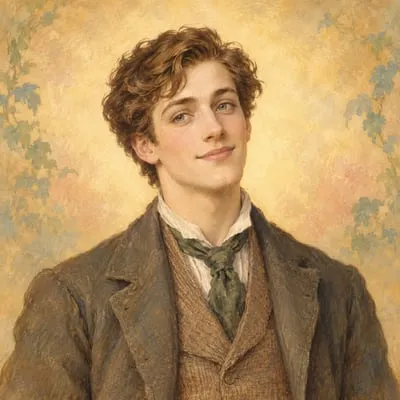
Hughie Erskine
The charming, penniless hero
A wonderfully good-looking young man with crisp brown hair and grey eyes, popular with everyone and, intellectually, 'not of much importance'. His father left him only a cavalry sword and a fifteen-volume history of the Peninsular War, and his attempts at business all fail. Generous and reckless, he gives his only sovereign to a beggar, is mortified to learn that the man is a millionaire, and is rewarded with the fortune that lets him marry.
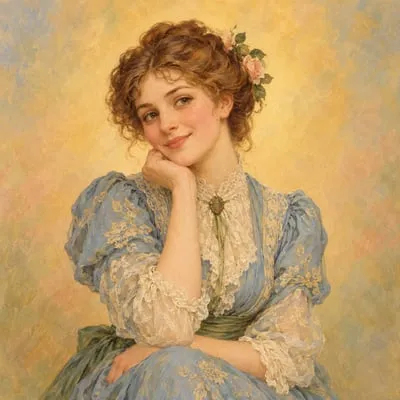
Laura Merton
The beloved
The daughter of a retired Colonel, who adores Hughie; together they are 'the handsomest couple in London' and have not a penny between them. She consoles him when her father refuses an engagement, and gives him 'a charming scolding' for his extravagance on the day he gives away his sovereign. The Baron's wedding present is addressed to her as well as to Hughie.
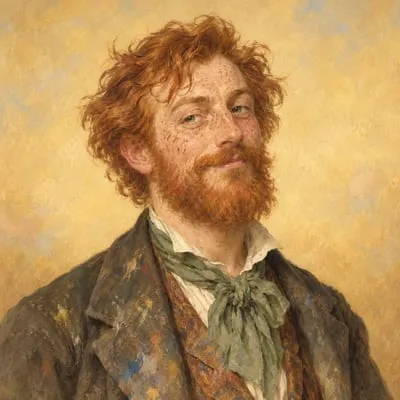
Alan Trevor
The painter
Hughie's great friend, a strange, rough-looking man with a freckled face and a ragged red beard, but a real master whose pictures are eagerly sought after. He first liked Hughie for his looks and then for his generous nature. Witty and unsentimental about art, he calls rags romance, laughs loudly at Hughie's gift, and becomes best man at the wedding, where he coins the title's pun.
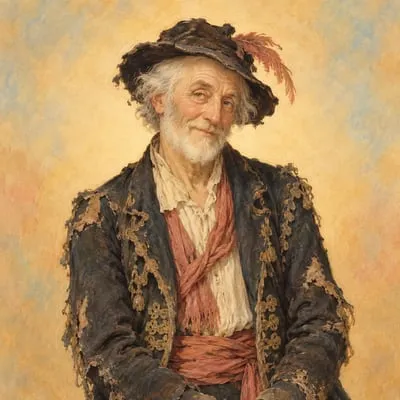
Baron Hausberg
The millionaire in rags
One of the richest men in Europe, who 'could buy all London tomorrow' and dines off gold plate. He buys all of Trevor's pictures and commissions a portrait of himself as a beggar, wearing an old suit of Trevor's from Spain. Hughie's pity delights him; he learns all about Hughie's affairs, sends a cheque for £10,000 'from an old beggar', and makes a speech at the wedding breakfast.
Colonel Merton
The practical father
Laura's father, a retired Colonel who 'had lost his temper and his digestion in India, and had never found either of them again'. He is very fond of Hughie but will not hear of an engagement, telling him to come back when he has ten thousand pounds of his own. The Baron's cheque meets his condition to the pound.
Monsieur Gustave Naudin
The Baron's messenger
An old gentleman with gold spectacles, grey hair and a slight French accent, who calls on Hughie at breakfast with a card announcing that he comes on behalf of Baron Hausberg. Hughie assumes he has come for an apology, but Naudin smiles, cuts short his stammered regrets, and hands over the sealed envelope that contains the wedding present.
Themes
Money and romance
The opening paragraph states the rules of Hughie's world: 'Unless one is wealthy there is no use in being a charming fellow.' Colonel Merton likes Hughie but sets a price on his daughter, and Hughie's failures in stocks, tea and sherry show that charm cannot earn it. The joke of the ending is that romance does triumph, but only because a millionaire pays for it. Wilde presents his cynical maxims as 'the great truths of modern life', then lets the story both prove and mock them.
Kindness rewarded
Hughie 'never said a brilliant or even an ill-natured thing in his life', and the narrator treats him as 'a delightful, ineffectual young man'. His one decisive act is an impulse of pity: seeing the model rest wretchedly on a bench, he gives away his only sovereign, thinking 'he wants it more than I do'. The gift costs him real comfort, a fortnight of walking home, and he blushes at it afterwards. The story works like a moral fable, in which a small, unselfish act done without hope of return is repaid ten thousand times over.
Art and poverty
Alan Trevor sees the beggar as a subject, not a man. 'What you call rags I call romance,' he tells Hughie, and he declares that the painter's business is 'to realise the world as we see it, not to reform it as we know it'. His model earns a shilling an hour while the picture sells for two thousand guineas, and Hughie's suggestion that models deserve a percentage is laughed away. The rags themselves are an old suit Trevor bought in Spain. Wilde lets the painter speak for art for art's sake, while quietly showing its indifference to real want.
Disguise and appearance
Nothing in the studio is what it seems. The 'amazing model', with a face 'like wrinkled parchment' and a battered hat held out for alms, is one of the richest men in Europe, a man who 'can prevent Russia going to war when he chooses'. Trevor is a 'strange rough fellow' who is also a true artist, and Hughie, the handsome idler, turns out to be the story's moral hero. The title turns on a pun: the Baron is both a millionaire who is a model and a model of what a millionaire should be.
Quotes
"It is better to have a permanent income than to be fascinating."
The narrator
"Unless one is wealthy there is no use in being a charming fellow."
The narrator
"there are moments when Art almost attains to the dignity of manual labour."
Alan Trevor
"An artist's heart is his head"
Alan Trevor
"our business is to realise the world as we see it, not to reform it as we know it."
Alan Trevor
Context
The Model Millionaire was first published in The World in June 1887, and was collected in 1891 in Lord Arthur Savile's Crime and Other Stories. Its subtitle, 'A Note of Admiration', is a pun: 'note of admiration' was an old name for the exclamation mark, and the story ends on Trevor's exclamation about model millionaires, as well as on admiration for the Baron.
The story belongs to the world of the London studio and club. Trevor calls his model 'a living Velasquez' and imagines the etching Rembrandt would have made of him, placing the picture in a long tradition of painting beggars. His claim that the painter's business is to realise the world rather than to reform it anticipates the view Wilde would state outright in the preface to The Picture of Dorian Gray, that art need serve no moral purpose.
First published in The World, June 1887; collected 1891.
About this edition
- Text: the complete work from Standard Ebooks, released into the public domain (CC0 1.0). We change only the layout.
- Download the EPUB of the whole book it comes from, free, for any e-reader.
- Audiobook: read by Alex Lau for LibriVox, in the public domain.
- Every quotation and glossary word in these notes is checked against the text.