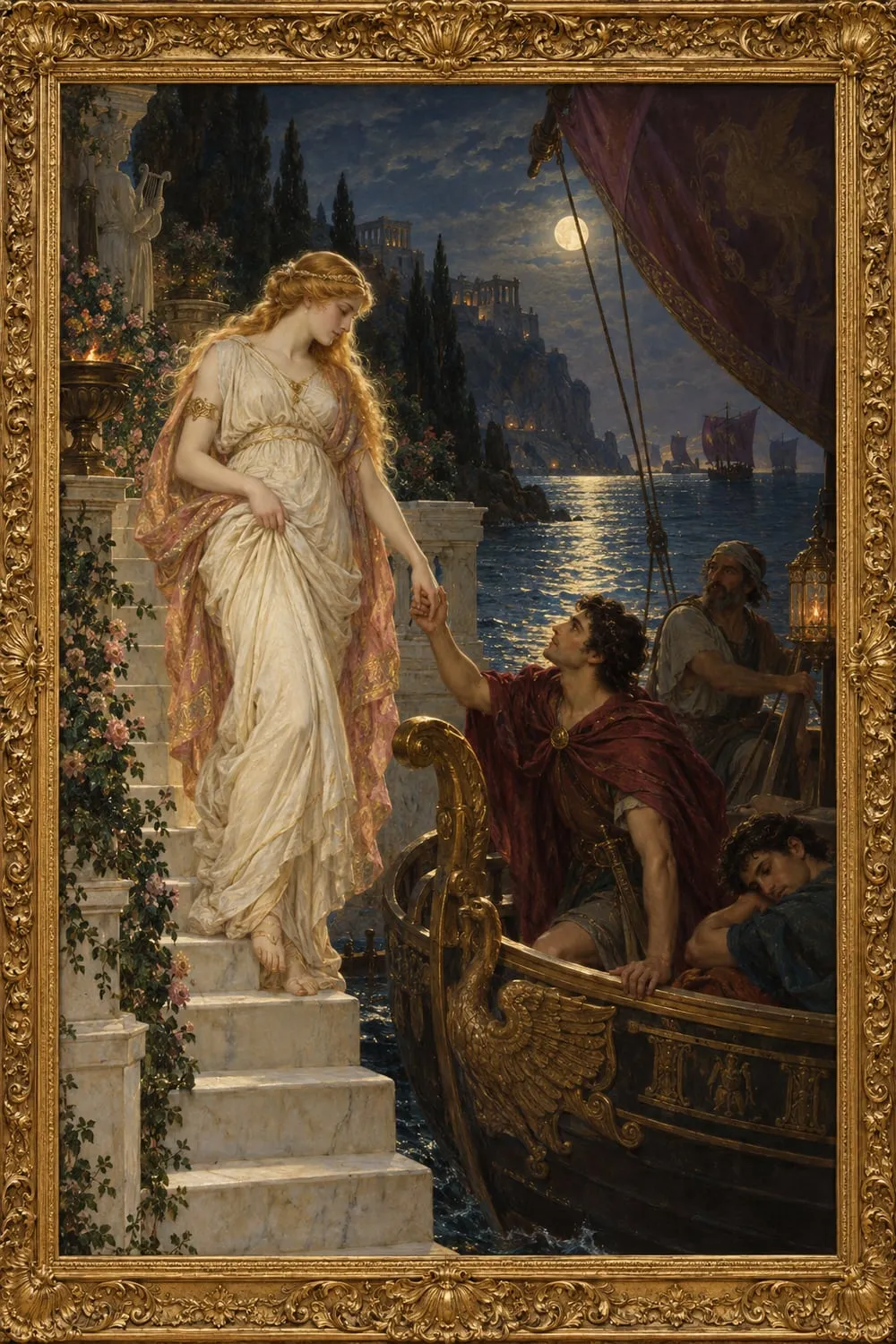
A lover's galley waits for Troy
Serenade
"O Lady mine come down, come down!"
Poem
(For Music)
The western wind is blowing fairAcross the dark Aegean sea,And at the secret marble stairMy Tyrian galley waits for thee.Come down! the purple sail is spread,The watchman sleeps within the town,O leave thy lily-flowered bed,O Lady mine come down, come down!
She will not come, I know her well,Of lover’s vows she hath no care,And little good a man can tellOf one so cruel and so fair.True love is but a woman’s toy,They never know the lover’s pain,And I who loved as loves a boyMust love in vain, must love in vain.
O noble pilot, tell me true,Is that the sheen of golden hair?Or is it but the tangled dewThat binds the passion-flowers there?Good sailor come and tell me nowIs that my Lady’s lily hand?Or is it but the gleaming prow,Or is it but the silver sand?
No! no! ’tis not the tangled dew,’Tis not the silver-fretted sand,It is my own dear Lady trueWith golden hair and lily hand!O noble pilot, steer for Troy,Good sailor, ply the labouring oar,This is the Queen of life and joyWhom we must bear from Grecian shore!
The waning sky grows faint and blue,It wants an hour still of day,Aboard! aboard! my gallant crew,O Lady mine, away! away!O noble pilot, steer for Troy,Good sailor, ply the labouring oar,O loved as only loves a boy!O loved for ever evermore!
In brief
SummaryA lover waits at night with his galley below a secret marble stair, the purple sail spread and the watchman asleep, and calls his Lady to come down. In the second stanza he despairs: she is cruel, cares nothing for vows, and he must 'love in vain'. Then he sees something gleaming on the shore and asks the pilot and the sailor whether it is her golden hair and lily hand or only dew and sand. It is she. He orders the ship to steer for Troy, bearing 'the Queen of life and joy' away from the Grecian shore.
Key themes
"My Tyrian galley waits for thee."

Summary
The poem is subtitled '(For Music)' and is written as a song in five eight-line stanzas. In the first, the west wind blows fair 'Across the dark Aegean sea', and the speaker's 'Tyrian galley' waits at 'the secret marble stair'. The purple sail is spread, the town's watchman sleeps, and he calls: 'O Lady mine come down, come down!'
In the second stanza his hope collapses. 'She will not come, I know her well', he says; she has no care for lovers' vows and is 'so cruel and so fair', and he who 'loved as loves a boy' must 'love in vain, must love in vain'. The third stanza is a string of questions to the crew. Is that 'the sheen of golden hair' he sees, or only 'tangled dew' among the passion-flowers? Is it his Lady's 'lily hand', or the gleaming prow, or the silver sand?
The fourth stanza answers with joy: 'No! no!' it is 'my own dear Lady true'. He tells the pilot to 'steer for Troy' and the sailor to 'ply the labouring oar', for they carry 'the Queen of life and joy' from the Grecian shore. The last stanza is the departure. The sky pales an hour before day, and he cries 'Aboard! aboard!' and 'away! away!', ending on a love that lasts 'for ever evermore'.
Characters
The lover
The waiting sailor-prince
The speaker, who waits with his Tyrian galley at a secret stair to carry off the woman he loves. He swings from eager hope to despair and back again, and when she comes he orders his crew to steer for Troy. The details of his story point to Paris.
The Lady
Queen of life and joy
The woman the lover calls down from her 'lily-flowered bed', whom he first thinks 'so cruel and so fair' and then sees coming, 'With golden hair and lily hand'. He carries her from 'Grecian shore' towards Troy as 'the Queen of life and joy'.
The pilot and sailor
The lover's crew
The 'noble pilot' and 'Good sailor' of the galley, whom the lover questions about what gleams on the shore and then orders to steer for Troy and 'ply the labouring oar'. They never answer in words.
Themes
Despair and triumph
The song swings between moods. The first stanza is eager ('Come down!'), the second hopeless ('She will not come, I know her well'), the third uncertain and full of questions, and the last two exultant. The refrains change to match: 'must love in vain' becomes 'O loved for ever evermore!' The speed of the turns suits a song, where each stanza can take a new key.
An old story retold
No names are given, but the 'Tyrian galley', the 'dark Aegean sea', the order to 'steer for Troy' and a 'Queen' carried off 'from Grecian shore' all point to Paris taking Helen from Greece. The poem tells the story as a night-time elopement, all longing and hurry, from the lover's side, and leaves out the war that followed.
Built for singing
Subtitled '(For Music)', the poem is made to be sung. Lines repeat with small changes ('come down, come down!', 'must love in vain, must love in vain', 'away! away!'), and the pilot and sailor are addressed in a matching pair: 'O noble pilot', 'Good sailor'. The short, even lines and regular rhymes make it closer to a song lyric than a reflective poem.
Quotes
"My Tyrian galley waits for thee."
The lover
"O Lady mine come down, come down!"
The lover
"O noble pilot, steer for Troy,"
The lover
Context
The Serenade appears in the Wind Flowers group of Wilde's Poems (1881), with the subtitle '(For Music)', marking it as a lyric written to be set as a song. Endymion, which follows it in the same group, carries the same subtitle. A serenade is a song sung by a lover at night beneath the beloved's window, and here the singer waits below a marble stair with a ship ready to sail.
About this edition
- Text: the complete work from Standard Ebooks, released into the public domain (CC0 1.0). We change only the layout.
- Download the EPUB of the whole book it comes from, free, for any e-reader.
- Every quotation and glossary word in these notes is checked against the text.