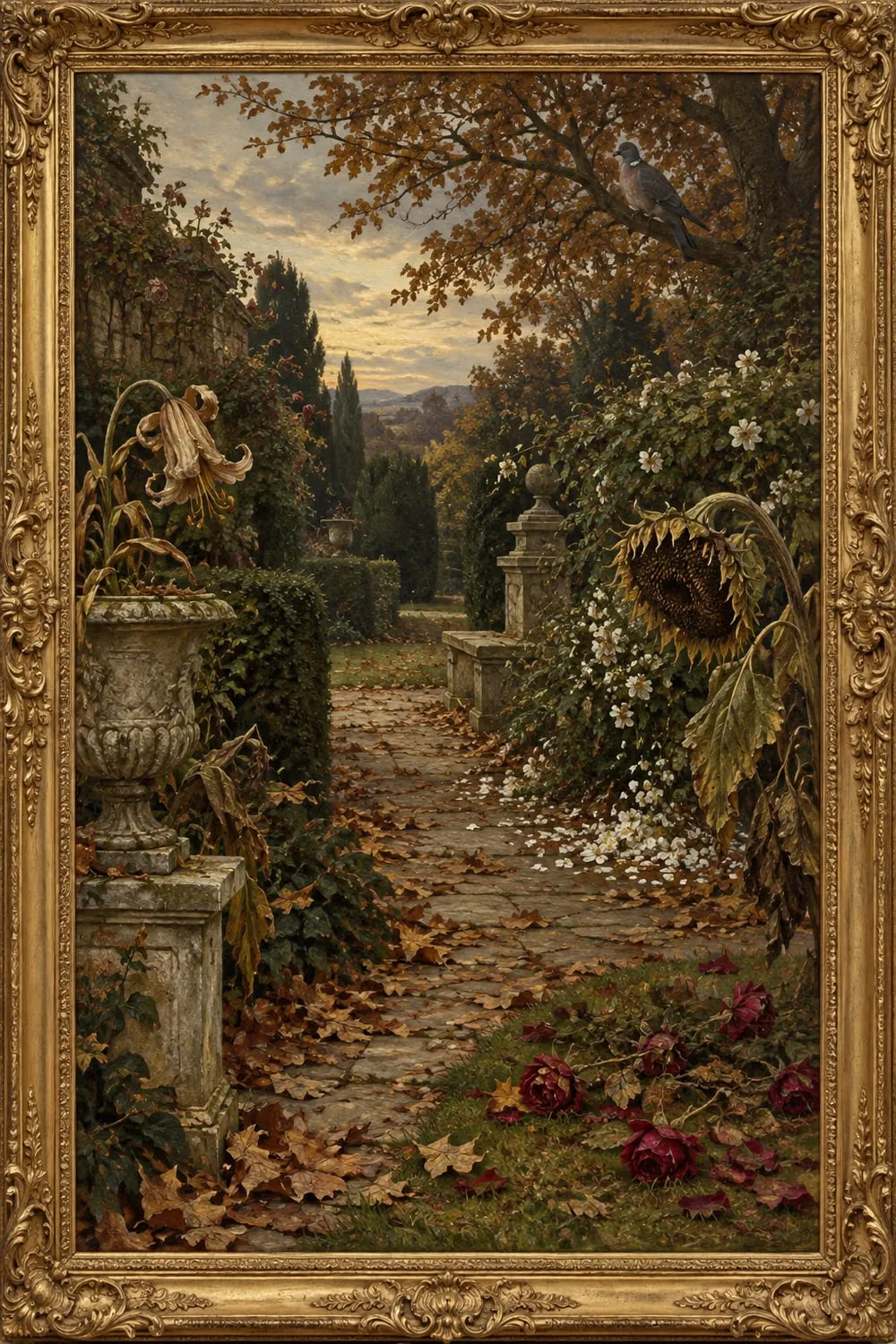
A garden at the end of summer
Le Jardin
"Like little shreds of crimson silk."
Poem
The lily’s withered chalice fallsAround its rod of dusty gold,And from the beech-trees on the woldThe last wood-pigeon coos and calls.
The gaudy leonine sunflowerHangs black and barren on its stalk,And down the windy garden walkThe dead leaves scatter—hour by hour.
Pale privet-petals white as milkAre blown into a snowy mass:The roses lie upon the grassLike little shreds of crimson silk.
In brief
SummaryThree short stanzas record a garden as its flowers fail. The lily's cup has withered around its golden stem, the last wood-pigeon calls from the beeches, and the once gaudy sunflower hangs 'black and barren'. Dead leaves scatter down the windy walk hour by hour, privet petals drift into a white heap, and fallen roses lie on the grass 'Like little shreds of crimson silk'. No speaker comments or confesses a feeling: the poem builds its mood of ending purely from what can be seen and heard.
Key themes
"The gaudy leonine sunflower"


Summary
The first stanza begins with decline. The lily's 'withered chalice falls / Around its rod of dusty gold', leaving the stem bare, while from the beech-trees on the wold 'The last wood-pigeon coos and calls'. The word 'last' sets the season: the garden has reached the end of its year.
The second stanza turns to the sunflower, once 'gaudy' and 'leonine', which now 'Hangs black and barren on its stalk'. The wind drives the dead leaves down the garden walk, and the closing words 'hour by hour', set apart from the rest of the line, slow it to the steady pace of the falling leaves.
The third stanza is almost all colour. Privet petals 'white as milk' are blown 'into a snowy mass', a hint of the winter to come, and the roses lie on the grass 'Like little shreds of crimson silk'. The closing simile turns decay into something delicate and costly, as though the garden were a torn and discarded dress.
Themes
Decay and the turning year
Every image records something ending. The lily's chalice is 'withered', the sunflower 'black and barren', the leaves 'dead', and the wood-pigeon is 'The last' to call. Even the privet petals, blown 'into a snowy mass', look forward to winter. The poem never names autumn; it lets the details announce it, one failing flower at a time.
Beauty in ruin
The poem mourns and admires at once. The dying lily still keeps its 'rod of dusty gold', the privet is 'white as milk', and the fallen roses become 'little shreds of crimson silk'. By comparing the wreck of the garden to a luxurious fabric, the last line makes the ruin itself lovely, in keeping with a group of poems called 'Impressions' that aim at colour and texture over argument.
Quotes
Context
Le Jardin, French for 'The Garden', appears in Wilde's collected poems under the heading 'Impressions', together with La Mer. It is written in three four-line stanzas of eight-syllable lines rhyming ABBA. Like the other Impressions, it sets down a scene in images alone, with no speaker saying 'I' and no reflection on what the scene means.
About this edition
- Text: the complete work from Standard Ebooks, released into the public domain (CC0 1.0). We change only the layout.
- Download the EPUB of the whole book it comes from, free, for any e-reader.
- Every quotation and glossary word in these notes is checked against the text.